
Introduction
Have you ever walked into a bank, hospital, or retail store only to find a long line of frustrated customers? You’re not alone, which is why many modern businesses are now discovering the benefits of implementing a self-service kiosk queue solution. Studies consistently show that customer satisfaction drops significantly when wait times exceed expectations, making smart queue management more critical than ever.
Businesses today face a major challenge: providing fast, efficient service while managing increasing customer demand. Unfortunately, traditional queue management methods often create bottlenecks, leading to longer wait times, overwhelmed staff, and dissatisfied customers.
Fortunately, this is where a self-service kiosk queue solution can make a significant difference. These digital systems allow customers to join a queue, select services, receive tickets, and track their waiting status without requiring staff assistance. The adoption of self-service technology has accelerated across industries because customers now expect convenience and speed. In contrast, organizations from healthcare to banking are using kiosk queue systems to improve service delivery.
In this article, we will break down the core benefits of implementing a self-service kiosk queue solution. We will explore how it improves customer satisfaction, reduces operational costs, enhances efficiency, and supports business growth. Whether you’re a business owner or a manager, this guide will help you understand why kiosk queue systems are essential.
1. Reduced Wait Times and Better Customer Experience
One of the biggest advantages of implementing a self service kiosk queue solution is the ability to reduce perceived and actual wait times through a modern kiosk Queue Management system.
Key Benefits Include:
- Faster registration: Speed up the initial check-in process.
- Organized service flow: Eliminate physical lines and confusion.
- Reduced crowding: Disperse waiting crowds across comfortable seating areas.
- Better customer communication: Keep visitors informed at every step.
Research shows that customers are generally more satisfied when they understand the waiting process, even if the actual wait time remains the same. Customers value transparency almost as much as speed. To learn more about optimizing these touchpoints, explore our comprehensive guide on customer experience management strategies.
Operational Advantages
| Traditional Queue | Self-Service Queue |
| Manual, staff-dependent ticketing | Automated kiosk ticketing |
| Inflexible routing and service queues | Dynamic, skill-based service routing |
| Limited, retrospective tracking | Real-time tracking and live status updates |
| High front-lobby congestion | Organized, spaced-out customer flow |
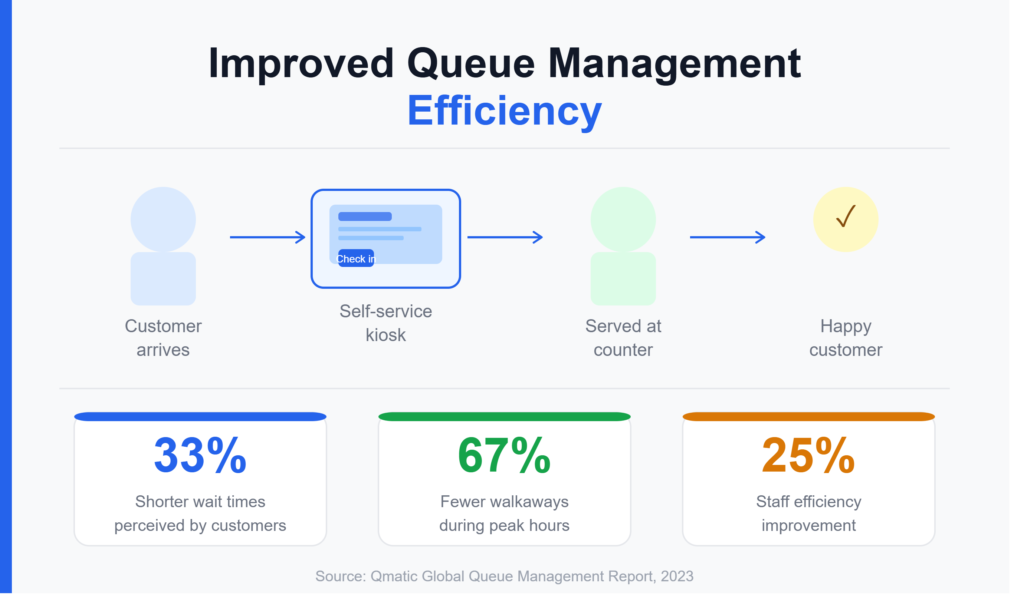
By leaning into automated customer flow management, managers can easily ensure that high-priority needs are met without manual sorting. For a deeper look at streamlining front-line workflows, read our breakdown of operational efficiency strategies for modern offices.
Real-World Example: A retail bank using self-service kiosks routes incoming visitors directly to specialized loan officers, business tellers, or customer service representatives based on the specific service selected at check-in.
3. Cost Savings and Higher Return on Investment
Implementing dedicated queue automation software can significantly reduce business operational costs over time. Although the initial setup requires an upfront investment, businesses often recover these costs quickly through improved employee efficiency and optimized staffing requirements.
Primary Cost-Saving Areas
- Reduced labor costs: Staff are freed from administrative check-in loops.
- Lower administrative workload: Paperwork and manual tracking disappear.
- Fewer service errors: Automated data inputs keep routing accurate.
- Better resource utilization: Managers know exactly where to deploy staff.
Organizations frequently report measurable improvements in overall operational productivity after adopting automated queue systems.
Before vs. After Kiosk Implementation
- Staff Hours Required: Reduced from 100 hours/week down to 70 hours/week.
- Average Customer Wait Time: Cut down from 20 minutes to just 8 minutes.
- Daily Visitors Served: Increased capacity from 300 visitors to 450 visitors.
Deploying agile queue automation software delivers clear bottom-line value. If you’re looking to upgrade other legacy systems, check out our insights on macro business process automation trends.
4. Real-Time Analytics and Data Insights
Modern self service kiosk queue solution software provides invaluable operational data through integrated queue analytics software. Without accurate, automated data, improving day-to-day customer service becomes a guessing game. Analytics reveal hidden bottlenecks and systemic inefficiencies that may otherwise go completely unnoticed.
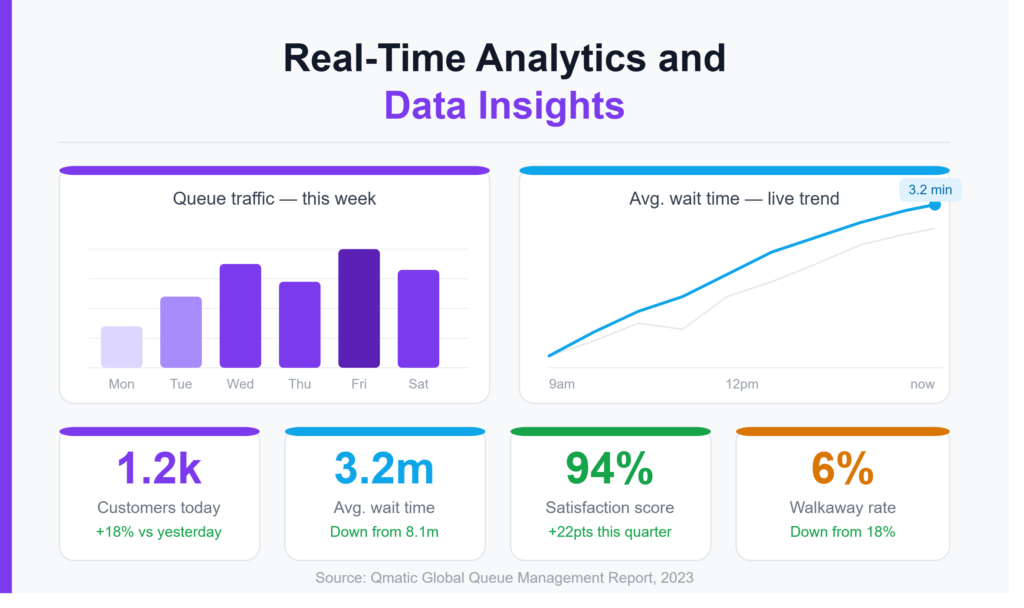
Core Metrics to Track:
- Daily Visitor Volume: Pinpoint exactly when your branches are busiest.
- Average Wait Times: Track if wait times vary across different services.
- Peak Service Hours: Identify regular historical traffic surges.
- Service Duration: Measure how long it takes staff to resolve specific tasks.
- Employee Performance: Reward high performers and spot training opportunities.
These real-time operational insights help administrators make proactive, data-driven decisions. To learn more about leveraging data in your business, view our framework on applying business analytics to operations.
Real-World Example: A busy retail storefront discovers via its analytics dashboard that customer traffic spikes dramatically between 4 PM and 6 PM on weekdays. Management adjusts staff shift schedules to ensure maximum floor coverage during those peak hours.
Customer satisfaction is directly linked to service quality, transparency, and speed. A modern self service kiosk queue solution elevates your customer service technology stack by giving visitors more direct control over their experience, reducing anxiety and friction.
5. Increased Customer Satisfaction and Loyalty
Long-Term Benefits for Customers:
- Significantly less wait-time frustration
- Faster overall service delivery
- Crystal-clear digital communication
- Unmatched everyday convenience
Happy, respected customers are highly likely to return and enthusiastically recommend your brand to others. According to leading industry studies by organizations like the Harvard Business Review on customer experience metrics, businesses that systematically improve customer experience achieve substantially higher retention rates and stronger, long-term brand loyalty.
Real-World Example: A busy government licensing bureau introduces interactive self-service kiosks. As a result, the agency receives significantly fewer public complaints regarding long line delays.
6. Versatile Applications Across Major Industries
One reason specialized self-service technology solutions continue to gain global popularity is their immense cross-industry versatility.
- Healthcare: Streamlining patient check-in, tracking appointment schedules, and handling dynamic department routing.
- Banking & Finance: Managing retail teller services, handling loan consultations, and organizing account support queues.
- Retail & Commerce: Coordinating customer assistance, managing returns processing, and speeding up product inquiries.
- Government Services: Enhancing driver licensing, document processing, and general citizen services.
- Telecommunications: Organizing service requests, handling hardware technical support, and account management.
To see how automation scales beyond front lobbies, browse our deep dive on digital transformation in customer service.
The Future of Smart Queue Management
The future of smart queue management is moving fast, and emerging technologies are making these interactive systems incredibly intelligent.
Key Future Trends to Watch:
- AI-Powered Routing: Systems that automatically adjust queues based on live staff performance metrics.
- Mobile Queue Integration: Seamless hand-offs from home appointment booking to in-store kiosk check-ins.
- Predictive Wait Times: Machine learning models that accurately forecast delays days in advance.
- Biometric Check-In: Facial recognition software for instant, secure account lookups.
- Cloud-Based Ecosystems: Managing queue structures across hundreds of global locations from a single cloud dashboard.
Forward-thinking organizations adopting these smart innovations early are gaining massive competitive advantages. For more context on where these trends are heading, read about the role of AI in customer service automation.
Frequently Asked Questions
Q1: What is a self service kiosk queue solution?
A self service kiosk queue solution is an integrated digital platform consisting of a touch-screen kiosk and back-end software. It allows visiting customers to register themselves, select their required service, print a ticket, and track their position via digital signage or mobile notifications.
Q2: How does digital queue management improve the customer experience?
It eliminates physical lines, removes wait-time uncertainty by displaying real-time estimations, and gives customers the freedom to wait comfortably rather than standing packed in a structural bottleneck.
Q3: Is queue automation software expensive to deploy?
Upfront costs vary based on your hardware selections and the number of branches, but most organizations achieve a net-positive return on investment within months through reduced labor overhead, lower error rates, and increased customer processing capacity.
Q4: Can queue analytics software genuinely help improve field operations?
Absolutely. The built-in software captures exact data points on peak hours, service bottlenecks, and individual staff transaction speeds, enabling resource managers to build staff schedules based on objective historical patterns.
Q5: Which physical industries benefit most from self-service kiosk queues?
Any industry with consistent in-person traffic can benefit. The most common sectors include healthcare systems, retail banking, high-volume retail stores, telecom service centers, and municipal government offices.
Q6: Are modern self-service kiosk queue solutions secure?
Yes. Enterprise-grade queue platforms implement advanced data security compliance, including encrypted data transmission protocols and secure user authentication layers to keep customer information safe.
Q7: Can kiosk systems seamlessly integrate with our existing software?
Most premium queue platforms offer robust API frameworks built to connect directly with your existing Customer Relationship Management (CRM) databases, ERP platforms, and internal appointment scheduling software.
Q8: What defines the future of smart queue management?
The evolution relies on artificial intelligence, predictive modeling, deep mobile application integrations, and cloud-hosted management systems to make customer journeys as frictionless as possible.
Conclusion
Implementing a self service kiosk queue solution is one of the most effective strategies available for modern businesses to eliminate front-lobby bottlenecks, elevate employee productivity, and radically improve overall customer satisfaction. By transforming traditional waiting lines into transparent, data-driven workflows, you turn a common point of customer friction into a professional, seamless experience that respects everyone’s time.