
The landscape of artificial intelligence is shifting under our feet. For years, the narrative around AI has been dominated by massive, cloud-guzzling large language models that ingest the entire public internet.However, a new paradigm is emerging—one centered on absolute privacy, local edge computing, and highly specialized domain expertise. At the forefront of this shift is AI Chester, a concept and tool framework that is radically altering our understanding of data sovereignty and specialized intelligence. Whether applied as an on-device clinical diagnostic powerhouse or a fortified corporate advisory agent, AI Chester is actively dismantling the old “one-size-fits-all” cloud infrastructure and paving a new way forward.
In this deep dive, we will explore how AI Chester is changing the future of artificial intelligence, why local processing is winning the compliance wars, and what this means for the next generation of digital transformation.
The Core Philosophy Behind AI Chester
To understand why this development is so significant, we have to look at the structural vulnerabilities of mainstream AI. Current foundational models rely heavily on continuous server communication, which introduces massive latency, high computational costs, and significant data privacy risks.
AI Chester flips this script completely by championing two major pillars:
- Zero Server Dependency (Edge AI): Processing complex neural networks directly inside a local environment or browser.
- Hyper-Specialized Context Capsulation: Restricting the AI’s learning boundaries so it remains an expert in its designated field without suffering from “hallucination creep.”
By keeping data entirely local and focusing strictly on specialized data frameworks, this approach solves the twin crises currently facing enterprise and medical AI adoption: trust and scalability.
3 Ways AI Chester Is Transforming the AI Industry
1. Revolutionizing Patient Privacy in Healthcare
In medical applications, traditional cloud-based AI faces massive regulatory hurdles under frameworks like GDPR and HIPAA. “Chester the AI Radiology Assistant,” an open-source prototype developed by researchers at the Montreal Institute for Learning Algorithms (MILA), proved that deep learning models could diagnose chest X-rays directly within a user’s local web browser.
Instead of uploading sensitive patient imagery to an external cloud server, the entire model is delivered via a URL and executed locally on the device. This approach offers several distinct advantages:
- Absolute Data Sovereignty: Patient files never leave the local machine.
- Zero Server Costs: The hosting organization doesn’t need to maintain millions of dollars in GPU cloud architecture.
- Global Accessibility: Clinicians in remote areas with unstable internet can run diagnostic checks locally once the application is cached.
2. Setting New Standards for Enterprise Trust and Governance
On the corporate side, executive implementations of AI Chester (such as specialized leadership thinking partners trained on private proprietary frameworks) demonstrate how enterprise AI can bypass public data ingestion completely. Chester Elton
According to research on enterprise AI adoption architectures, organizations are increasingly rejecting models that learn from user conversations. A closed-source, privately maintained system ensures that a company’s strategic decisions, financial data, and internal organizational health remain completely contained. It acts as a specialized peer that supports human judgment rather than trying to replace it.Chester Elton
3. Overcoming the “Black Box” Problem with Localized Interpretability
Mainstream AI systems struggle with explainability. When a multi-billion parameter cloud model outputs an answer, tracing the exact node pathway is nearly impossible. Because AI Chester implementations operate within bounded, specialized environments, they integrate advanced “prediction explanation” modules right at the source. Users can see precisely which local variables or structural data points triggered a specific outcome.
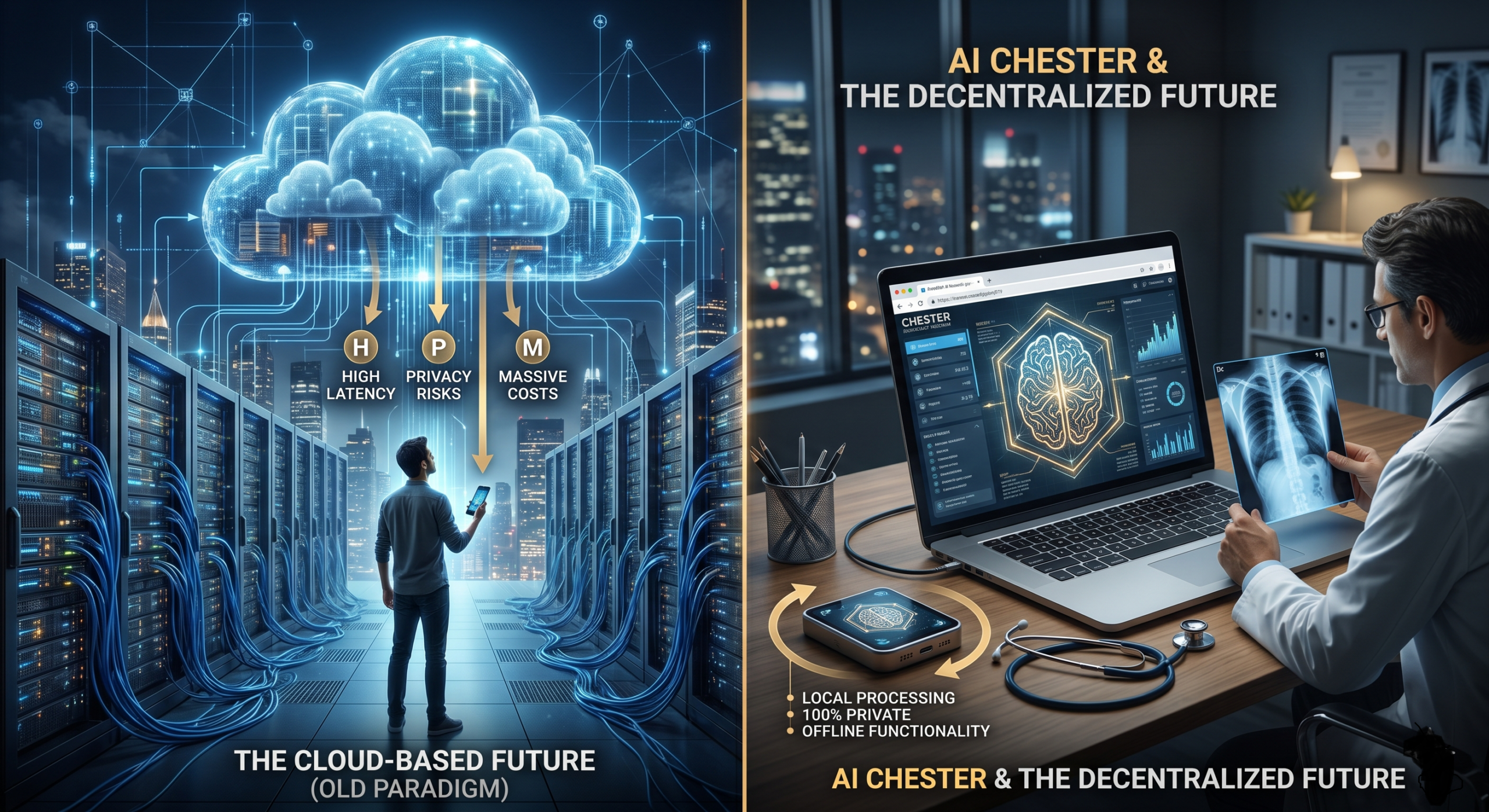
| Infographic Suggestion: Cloud AI vs. Localized AI Architecture Visual Description: A side-by-side comparative infographic layout optimized for mobile screens. • Left Side (Traditional Cloud AI): Shows an image of a user device uploading sensitive data through arrows to a giant public cloud server, labeled with “High Latency,” “Privacy Risks,” and “Massive Server Costs.” • Right Side (AI Chester Local Model): Shows a user device containing the entire AI model internally. Arrows loop safely inside the device, labeled with “Local Processing,” “100% Privacy Assurance,” and “Zero Data Leaks.” |
Technical Benchmarks: The Power of Localized Processing
The technical shift behind AI Chester is backed by concrete performance metrics. Local execution engines running via JavaScript or local edge environments have minimized the gap between local devices and cloud servers.
| Feature Matrix | Traditional Cloud-Based AI | AI Chester Framework |
| Data Location | Transmitted to external servers | Stays completely on-device |
| Internet Dependency | Continuous high-speed connection required | Works completely offline after initial load |
| Data Privacy | Subject to third-party data policies | 100% private and localized |
| Computational Cost | High recurring API or hosting fees | Zero server-side processing costs |
| Primary Use Case | Broad, generalized text/image generation | Deep, hyper-specialized vertical tasks |
The Future Landscape: What Happens Next?
As we move deeper into the next decade of automation, the hyper-centralization of artificial intelligence will likely diminish.As a result, the industry is shifting toward a hybrid ecosystem. In this new model, massive clouds handle broad, generalized creative tasks. “On the other hand, specialized tools like AI Chester manage high-consequence operations in medicine, corporate leadership, and legal analysis”
| “The true maturation of artificial intelligence isn’t found in making models bigger; it is found in making them smaller, more secure, and perfectly tailored to local environments.” |
Key Takeaways for Businesses and Developers:
- Prioritize Edge Solutions: Look for ways to bring models to the data rather than bringing data to the models.
- Focus on Trust over Scale: Building a highly secure, closed-source system often yields higher corporate adoption than a massive open-ended system.
- Invest in Explainability: Ensure your AI architectures include local prediction explanation components to satisfy strict regulatory standards.
Conclusion: Embracing the Local AI Revolution
The evolution of AI Chester proves that the future of artificial intelligence isn’t just about raw computational power—it is about accessibility, trust, and structural integrity. By proving that high-performance deep learning models can operate securely within local, private, or browser-based frameworks, it sets a brand-new blueprint for responsible tech integration.
As an organization or developer, continuing to rely solely on massive, privacy-exposed cloud networks could leave you behind in the next wave of compliance and efficiency. The decentralized future is already here.
🔗 Explore More Resources
Internal Links:
- Mastering Topical Authority and Structural Content Design: https://dailyopensource.com/topical-authority-guide
- Emerging Open Source Web Frameworks and Performance Trends: https://dailyopensource.com/open-source-trends
External Authority Sources:
- IBM Artificial Intelligence Research Hub: https://www.ibm.com/think/topics/artificial-intelligence
- Montreal Institute for Learning Algorithms (MILA) Project Portal: https://mlmed.org/w/chester-the-ai-radiology-assistant/