
Introduction

SaaS vendors, cybersecurity vendors, managed services providers, and tech consultants – content marketing has become one of the most powerful ways to grow your business. In 2026, the buyer will no longer buy any product. The buyer will conduct research of threats, evaluate solutions, verify facts and discover reliable vendors.
Here comes the hard part. People who work in cybersecurity are very knowledgeable. Security officer, IT specialist, engineer, compliance officer, even procurement officer – all of these will immediately understand if there is something wrong with your marketing content. They are not fond of buying anything that is overstated, buzzword-filled and relies on fear. They need valuable information, data, clarification, and content.
In this guide, you will learn about the most effective tactics of cybersecurity content marketing in 2026. You will discover how to develop content for the correct target audience, gain credibility and trust, cope with the long cycle of B2B sales, and convert leads into qualified.
Why Cybersecurity Content Marketing Matters in 2026
Cybersecurity is also on the board agenda, with companies faced with artificial intelligence (AI) threats, ransomware, identity attacks, cloud vulnerabilities, regulation issues, and increasing needs to ensure sensitive data protection.
In this respect, potential customers do extensive research prior to contacting sales teams – they read blog posts, download reports, analyze different vendors’ products, view webinars and even ask questions through AI-powered search engines.
Recently, there was a report analyzing key trends in cybersecurity marketing, which concluded that content marketing and thought leadership strategies make up to 15–25% of cybersecurity marketing budget.
Successful cybersecurity content marketing strategy will help your brand:
- Establish credibility among technical and executive audiences
- Enhance visibility in organic search
- Attract high-quality inbound leads
- Support account-based marketing initiatives
- Educate buyers throughout extended sales cycles
- Build brand trust and authority
- Develop content to support your sales, social media and e-mail campaigns
For a company like Nimbus Analytics, content can also connect cybersecurity performance with business intelligence, analytics, risk reporting, and data-driven decision-making.
Understand Your Cybersecurity Audience First
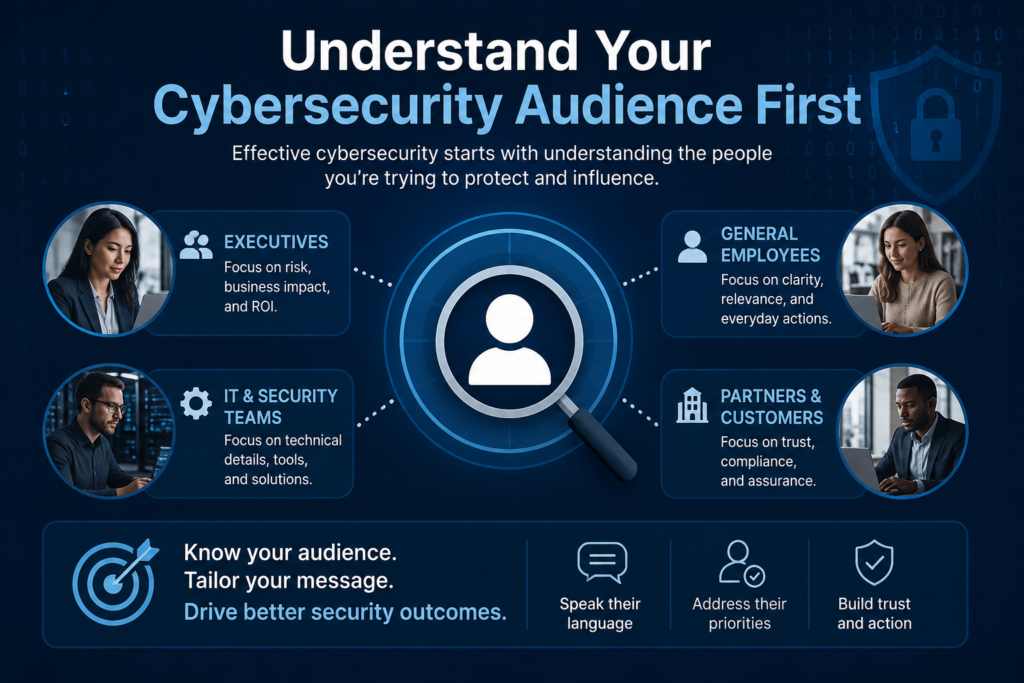
The most effective cybersecurity content marketing starts with customer discovery. Typically, there is not just one stakeholder involved in the security decision-making process, and each has their own set of interests.
CISOs might be interested in business risk, compliance, and board reporting, while security engineers could be more concerned with integration capabilities, effectiveness, implementation effort, and documentation.
Build Content for Multiple Buyer Roles
Create audience profiles for the people involved in your buying process.
Common cybersecurity buyer roles include:
- Chief Information Security Officers
- IT directors and IT managers
- Security operations center teams
- Compliance and risk officers
- Cloud architects
- DevOps and engineering leaders
- Procurement teams
- CEOs and board members
Each role should receive content that answers its specific questions.
For example, a CISO-focused article could explain how security analytics improves risk visibility. A technical guide could show how to evaluate security monitoring tools. An executive report could focus on the business cost of poor cyber risk management.
Focus on Trust Instead of Fear-Based Messaging
Fear-based messaging has been common in cybersecurity marketing for years. Many brands rely on phrases such as “your business is at risk” or “hackers are coming for your data.”
While cybersecurity risks are real, fear alone no longer makes content effective. Security buyers are tired of exaggerated claims and generic threat warnings.
In 2026, the strongest cybersecurity content marketing approach is credibility-first marketing. Instead of creating panic, help readers understand the problem, evaluate options, and take practical action.
Replace Fear With Useful Education
Avoid content that only highlights threats. Create content that explains how organizations can reduce risk.
For example, instead of writing:
“Your company could be the next ransomware victim.”
Write:
“How to Build a Ransomware Readiness Plan for Hybrid Work Environments.”
The second approach is more useful, more trustworthy, and more likely to attract decision-makers who are actively researching solutions.
Create Content Around Real Buyer Questions
The most effective content marketing campaigns related to cybersecurity would definitely be those which are based on real questions that arise from customers.
Keyword research, sales call listening, help desk tickets analysis, customer interviews, participation in forums and analysis of competitive actions are some ways to come up with questions.
These questions may be:
How can organizations get visibility about cloud security?
What information needs to be included in the cybersecurity risk dashboard?
How can businesses prepare for cybersecurity risks using AI?
What is the difference between SIEM and security analytics?
How can businesses measure ROI for cybersecurity?
What are the hardest cybersecurity compliance problems for 2026?
These topics help you create content that matches search intent.
Use a Full-Funnel Content Strategy
Make sure that your content supports all stages of the customer journey.
Awareness stage content provides insights into the problem.
Example: “Top Cybersecurity Challenges for Medium-Sized Companies in 2026.”
Comparison stage content gives insights into solutions.
Example: “Security Information and Event Management vs Security Analytics. Which One Should You Choose?”
Vendor/product evaluation stage content helps to choose among vendors.
Example: “Cybersecurity Analytics Platform Checklist for Enterprises.”
Retention stage content helps to add more value.
Example: “Making Better Executive Reports Using Security Data.”
High-Performing Cybersecurity Content Formats
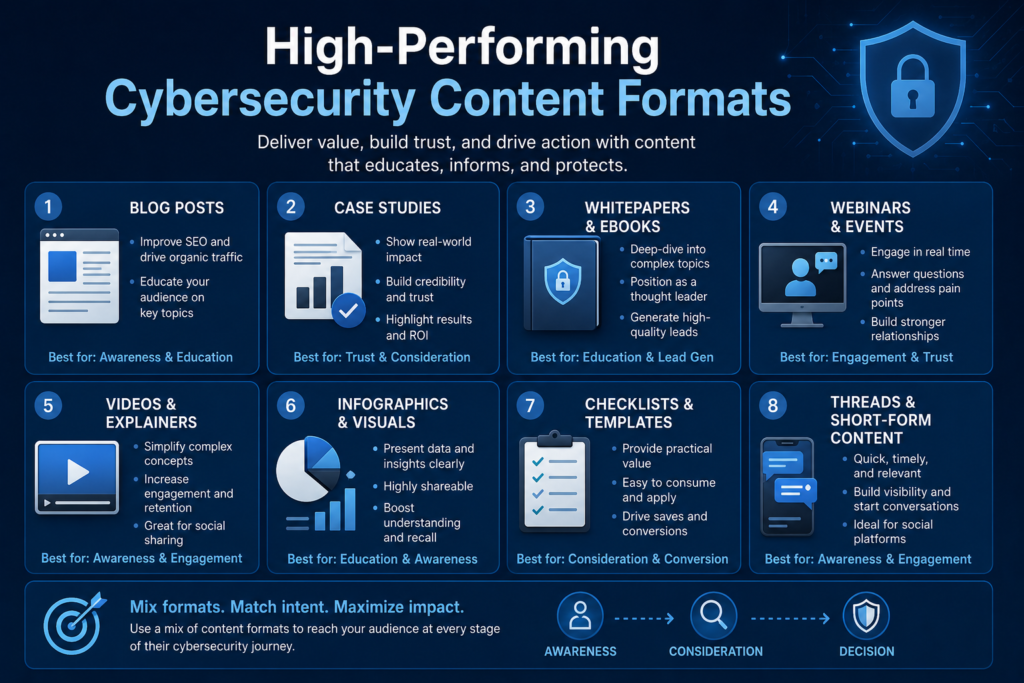
Consider adding these formats to your cybersecurity content marketing plan:
- Threat intelligence reports
- Security trend reports
- Technical how-to guides
- Compliance checklists
- Security assessment templates
- Product comparison guides
- Case studies
- Webinars and virtual events
- Expert interviews
- Cybersecurity glossary pages
- Incident response lessons
- Data-driven research reports
A strong example is a downloadable “Cybersecurity Risk Dashboard Template” that helps executives track key risk indicators. This type of asset can attract qualified leads while positioning your company as a practical resource.
Optimize Cybersecurity Content for SEO and AI Search
Search engine optimization remains essential, but cybersecurity content marketing in 2026 must also consider AI-powered search experiences.
Buyers increasingly use AI tools and search summaries to research cybersecurity topics. Your content should be structured so both traditional search engines and AI systems can understand it.
SEO Best Practices for Cybersecurity Content
Use the main keyword, cybersecurity content marketing, naturally in:
- The page title
- Meta description
- Introduction
- H2 and H3 headings
- Image alt text
- URL slug
- Conclusion
- Internal links
Also include related keywords such as:
- cybersecurity marketing strategy
- B2B cybersecurity content
- cybersecurity SEO
- security awareness content
- cybersecurity lead generation
- security analytics marketing
- CISO content strategy
- cybersecurity thought leadership
Make Content Easy to Scan
Use short paragraphs, descriptive headings, bullet points, and clear explanations. This improves user experience and makes content easier for search engines and AI tools to interpret.
Include direct answers to common questions. For example:
What is cybersecurity content marketing?
Cybersecurity content marketing is the process of creating educational, useful, and trust-building content that helps security companies attract, educate, and convert potential buyers.
This format can improve your chances of appearing in featured snippets, AI search summaries, and voice search results.
For additional guidance, readers can explore the NIST Cybersecurity Framework and the CISA cybersecurity resources.
Use Data, Research, and Real Examples
Trust is one of the most valuable assets in cybersecurity marketing. Back your claims with credible research, expert commentary, customer stories, and original data.
For example, the 2025 ISC2 workforce study reported that 69% of respondents experienced multiple cybersecurity incidents in their organization because of skills shortages.
Statistics like this give your content more credibility and help readers understand why a topic matters.
Develop a Practical Content Calendar
Consistency matters. With a content calendar, your team will publish more consistently, tying your content to campaigns, product launches, industry events, and seasonal timing.
For example, a basic cybersecurity content calendar for a month might have:
- Two SEO-focused blog posts
- One expert-authored piece of content
- One customer success story
- One downloadable resource
- Four to eight LinkedIn posts
- One email newsletter
- Either a webinar or an event
Quality matters more than quantity. One well-researched article that directly addresses a customer’s question beats ten mediocre blog posts any day.
Cybersecurity Content Marketing Mistakes to Avoid
Most cybersecurity brands create content, but fail to see results from their efforts by making several avoidable mistakes.
These mistakes often include:
- Only writing about products instead of buyer pain points
- Using too many industry terms without explaining them
- Creating generic content that fails to provide new insight
- Not focusing on the technical reader
- Relying only on fear-based messaging
- Not updating old content pieces
- Measuring vanity metrics instead of pipeline results
- Creating content without a clear CTA
- Not promoting the content via email, social, and sales channels.
The goal is not simply to publish more. The goal is to publish content that earns attention, trust, and action.
Conclusion: Build Growth from Cybersecurity Content Marketing
In 2026, cybersecurity content marketing is not just about keyword rankings. It is about helping buyers make informed decisions in an incredibly complex and risky market environment.
The winning brands will develop useful, believable, and data-driven content for the technical and C-suite audiences. They will prioritize education over marketing buzzwords, leverage analytics to track their impact, and create a complete ecosystem of content marketing.
Start by finding out what questions you want your buyer to answer. Then develop practical and informative content, which solves those questions better than the competition.
If your company needs help transforming security data, marketing performance metrics, and customer insights into smart decisions, let’s talk about how Nimbus Analytics can help you with your business and analytics strategy.
FAQs About Cybersecurity Content Marketing
1.What is cybersecurity content marketing?
Cybersecurity content marketing is the process of creating helpful, educational, and relevant content for people researching cybersecurity risks, tools, services, and strategies. It helps cybersecurity companies attract potential customers, build trust, and guide buyers toward a solution.
This content can include blog posts, threat reports, webinars, case studies, checklists, videos, email newsletters, and technical guides.
2.Why is cybersecurity content marketing important in 2026?
Cybersecurity buyers are more informed than ever. Before contacting a vendor, they often research threats, compare platforms, review compliance requirements, and look for trusted experts online.
Cybersecurity content marketing helps brands appear in search results, demonstrate expertise, answer buyer questions, and build credibility throughout the B2B buying journey.
3.What types of cybersecurity content perform best?
The best-performing cybersecurity content is practical, accurate, and tailored to a specific audience. Popular formats include:
- Cybersecurity threat reports
- Technical implementation guides
- Compliance checklists
- Security assessment templates
- Product comparison pages
- Customer case studies
- CISO-focused executive reports
- Webinars and expert interviews
- Incident response playbooks
- Cybersecurity glossary articles
Content that solves a real problem is usually more valuable than content that only promotes a product.
4.How can cybersecurity companies improve SEO with content marketing?
Cybersecurity companies can improve SEO by targeting relevant keywords, answering common buyer questions, using clear headings, and publishing in-depth content regularly.
Important SEO practices include using the keyword cybersecurity content marketing naturally in titles, headings, meta descriptions, image alt text, and internal links. Companies should also update older articles to reflect new threats, regulations, and technologies.
5.How often should a cybersecurity company publish content?
There is no single publishing schedule that works for every company. However, many cybersecurity brands benefit from publishing two to four high-quality pieces of content per month.
A consistent schedule is important, but quality matters more than volume. One well-researched guide that ranks in search results and generates leads can be more valuable than several short, generic articles.
6.How do you measure cybersecurity content marketing success?
Cybersecurity content marketing success should be measured using both engagement and business metrics.
Key performance indicators include:
- Organic traffic
- Keyword rankings
- Content downloads
- Webinar registrations
- Email sign-ups
- Demo requests
- Marketing-qualified leads
- Sales-qualified leads
- Conversion rates
- Pipeline influenced by content
- Customer acquisition cost
Using analytics and business intelligence tools can help teams connect content performance with revenue outcomes.
7.What is the biggest mistake in cybersecurity content marketing?
One of the biggest mistakes is focusing too heavily on fear-based messaging or product promotion. Cybersecurity buyers want useful information, clear explanations, and evidence that a company understands their challenges.
The strongest content educates first and sells second. It should help readers understand risks, compare options, and take practical steps toward improving their security posture.
8.Can cybersecurity content marketing generate B2B leads?
Yes. Cybersecurity content marketing can generate qualified B2B leads when it targets the right audience and includes relevant calls to action.
For example, a company can offer a downloadable cybersecurity checklist, risk assessment template, webinar registration, or security analytics consultation in exchange for contact information. The content should provide real value before asking readers to take the next step.