
Getting a US bachelor’s degree used to mean one thing: packing a suitcase at eighteen and committing to four years of American tuition, American rent, and American everything.That math never worked for most families outside the US.Specifically, Fortunately, the American Degree Transfer Program or ADTP, changed the equation entirelySpecifically, it lets a student sit in a classroom in Kuala Lumpur, Seoul, or Nairobi, complete real US credit hours, and walk onto a US campus two years later as a junior, not a freshman.
This isn’t a shortcut or a watered-down version of American education. It’s the same 120-credit modular system US universities have used for a century, delivered through a different front door. Understanding why the american transfer degree program works the way it does — and how to pick a strong one — starts with looking at where the model came from.
The Historical Roots of the American Degree Transfer Program
Educators didn’t invent the academic blueprint behind the ADTP for international students. Instead, they borrowed it directly from…
The 2+2 Concept
US community colleges were designed to make higher education affordable and accessible.Under this model, a domestic student could knock out two years of lower-division General Education requirements at a local college, then transfer to a four-year state university to finish the degree. Two years locally, two years at the university — hence “2+2.”
The Credit System Matrix
Here’s the detail that makes the whole thing possible: American degrees don’t lock you into a rigid, single-subject track from day one the way British or continental European degrees often do Instead, the US relies on a modular credit system. As long as you accumulate roughly 120 compatible credit hours spread across broad categories, and you’ve earned a degree.
International educators spotted the opening in that structure decades ago.Consequently, If the first two years of an American degree are just general education credits, there’s no rule saying those credits have to be earned on US soil.
The 1980s and 1990s: The Birth of Twinning and Transfer Programs
Formal globalization of this model took off in the late 1980s and early 1990s, with Southeast Asia — Malaysia, Singapore, Hong Kong — leading the way.
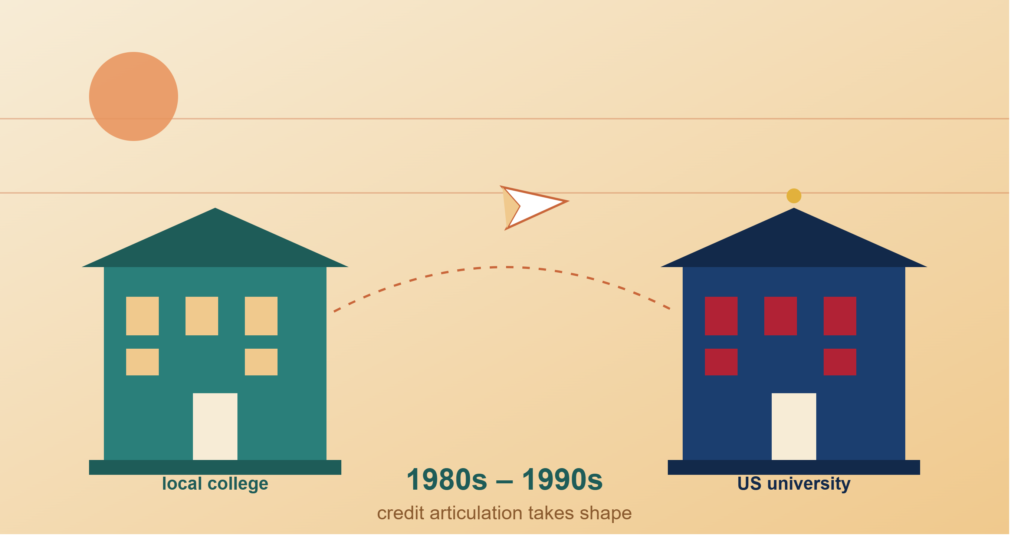
The economic catalyst was straightforward. Rapidly developing economies needed skilled professionals fast: engineers, business graduates, computer scientists. A US degree carried real weight in the job market, but sending a teenager abroad for four full years was out of reach for most middle-class households. Currency costs alone made a four-year US stay brutal on family budgets.
In fact, the regulatory breakthrough came when local ministries of education started partnering with private colleges to build formals In fact, Local institutions mapped their syllabi, their textbook choices, even their grading matrices to match American standards line for line. A Calculus course taught in a private college in Kuala Lumpur had to look, on paper, identical to the same course at San Jose State or the University of Minnesota.
That’s what makes the ADTP different from a generic “study abroad prep” course. The credits earned locally aren’t a rough equivalent — they’re the same credits, recognized the same way, transferring cleanly into the same degree.
Why the American Degree Transfer Program Pathway Endures
The ADTP’s staying power comes from how tightly it mirrors the Liberal Arts philosophy baked into American undergraduate education. Every US degree, regardless of major, splits roughly into two phases.
The General Education Core (Years 1 and 2)
Whether a student is heading toward Art History or Aerospace Engineering, US universities require a broad foundation before specialization begins:
- Quantitative Reasoning — Mathematics and Statistics
- Natural Sciences — Physics, Chemistry, or Biology, usually with mandatory lab hours
- Social Sciences — Psychology, Sociology, Macroeconomics
- Humanities — Literature, Philosophy, Global History
Because the US higher education system standardizes these courses, they form the entire curriculum of the local ADTP phase. A student can complete all of this without setting foot in the United States.
Upper-Division Specialization (Years 3 and 4)
Here’s a quick breakdown of how the pathway typically maps out phase by phase:
| Program Phase | Core Focus / Requirements | Key Consideration for Students |
|---|---|---|
| Local GenEd Phase (Yrs 1–2) | Standardized courses in math, science, social science, and humanities matched to US syllabi | Choosing a partner college with a genuine, active articulation agreement — not just marketing language |
| Credit Articulation | Local courses mapped against a specific receiving university’s course catalog | Confirming the exact credit-hour count (typically 30–60 credits) accepted on transfer |
| GPA Threshold Period | Maintaining a strong cumulative GPA to remain eligible for the guaranteed transfer slot | Some partner universities set minimum GPA cutoffs around 2.75–3.3 depending on competitiveness |
| Upper-Division Transfer (Yrs 3–4) | Entering the US campus as a junior for major-specific, advanced coursework | Housing, visa timing, and academic advising all shift at this stage and need early planning |
| Visa and Documentation | Converting from a local study visa to a US F-1 student visa | Processing timelines vary; strong ADTP programs run dedicated placement offices for this |
| Final Degree Conferral | Diploma issued directly by the US university, identical to one earned by an on-campus four-year student | The transcript shows continuous enrollment, not a “transfer stigma” — a real advantage on job applications |
Modern Evolution: Beyond Cost Savings
The ADTP started as a way to cut costs. However, it hasn’t stayed that way. Three other benefits now drive most enrollment decisions.
Academic cushioning matters more than most applicants expect. The jump from rigid, memorization-heavy high school systems to the continuous-assessment style of US universities — quizzes, presentations, group projects, weekly papers — trips up a lot of first-year students. The ADTP softens that landing.Consequently, Students adjust to American academic expectations inside smaller local class sizes before facing a 300-person lecture hall in the US.
GPA re-centering is arguably the single biggest reason competitive students choose this route deliberately, not just as a fallback. US universities weigh recent college-level performance heavily, sometimes more than high school records. A student who missed the admissions cutoff for a top-tier university straight out of high school can use two years of strong ADTP performance to rebuild their academic profile from scratch. A clean, high transcript from the ADTP phase can open doors that were closed at eighteen.
Visa and administrative streamlining is the quiet advantage nobody talks about until they’re buried in paperwork. Established ADTP programs run dedicated university placement centers with direct lines to US admissions officers. That relationship cuts through a lot of the friction — F-1 visa timing, credit validation, housing coordination — that independent transfer applicants have to figure out alone.
How to Choose the Best American Degree Transfer Program
Not every program marketed as an ADTP delivers the same value. A few things separate a strong program from a weak one:
- Verified articulation agreements — ask the college to name the exact US universities and confirm the agreement is current, not expired or informal
- Faculty credentials matched to US standards — instructors should hold qualifications recognized by the partner institution’s accreditation body
- Transparent credit transfer rates — a program should be able to tell you, in writing, how many credits typically transfer, not just how many “could”
- Track record of successful transfers — ask for recent transfer data, not just brochure testimonials
- Dedicated advising for visa and housing — this is where weaker programs quietly fall short, leaving students to handle F-1 logistics alone
A program that hedges on any of these points, especially the articulation agreement itself, is worth a harder look before enrollment.
The Bottom Line for International Students
The American Degree Transfer Program isn't a workaround. Nor is it a lesser path into US higher education.Instead, it’s the same modular credit system American students have used for generations, just accessed from a different starting point. Because the credits are genuinely equivalent, a student who goes this route ends up with a diploma from a US university that looks exactly like one earned by someone who spent all four years on campus. On top of that, they get there at a fraction of the cost, with a gentler academic transition, and often a stronger transcript than they’d have built otherwise.
So, for a student weighing options right now, the real question isn’t whether the ADTP model is legitimate. It clearly is. Instead, the real work is figuring out which local program has an articulation agreement worth trusting. After all, the value of the whole pathway rests on that one detail.