
Most AI governance programs fail for a boring reason: they treat every model, every dataset, and every deployment as if it carries the same risk.A recommendation engine suggesting playlists gets the same review checklist as a credit-scoring model. The latter decides who qualifies for a loan.That’s not caution. That’s noise dressed up as diligence.Business context refinement is the discipline that fixes this. It’s the practice of calibrating governance controls — documentation depth, review cadence, approval thresholds, monitoring intensity — to the actual business stakes of a given AI system, rather than applying a flat, one-size-fits-all policy across an entire organization. As AI governance matures from a compliance checkbox into an operational function, context refinement is becoming the mechanism that separates programs people actually follow from programs people quietly route around.
Why Generic AI Governance Frameworks Break Down at Scale
A governance policy written in the abstract sounds reasonable on paper.Every model gets a risk assessment, while each dataset requires a lineage record. On top of that, every deployment must clear a formal review board. Then the organization scales past a dozen models. Soon, the queue behind that review board stretches into weeks.
Data scientists start gaming the intake form to avoid triggering the “high-risk” tier. Meanwhile, business units quietly deploy shadow models outside the governed pipeline because the sanctioned path is too slow..The governance function, meant to reduce risk, ends up increasing it. This happens because the riskiest activity moves off the books, completely invisible to the controls designed to catch it.
The root cause isn’t laziness or bad faith. It’s that generic frameworks ignore a basic truth: risk in AI systems is not intrinsic to the algorithm. It’s a function of what the algorithm touches.A gradient-boosted model and a large language model carry wildly different risk profiles. It all depends on whether they influence a marketing email or a hospital triage decision. Context refinement asks a different question than “is this AI?” It asks “what happens if this AI is wrong, and who bears that cost?”
Defining Business Context in AI Governance
Business context refinement pulls in variables that traditional model-risk frameworks often leave out entirely:
Decision reversibility. Can a human easily override or undo the AI’s output before harm occurs?A model flagging suspicious transactions for human review carries a lighter governance weight. In contrast, a system that auto-blocks accounts in real time needs much stricter oversight.
Population exposure. Does the model touch ten internal employees or ten million customers? Blast radius matters as much as error rate.
Regulatory surface area. Is the use case sitting inside a regulated domain like lending, hiring, or healthcare? If so, frameworks like the EU AI Act already set a strict floor for documentation and testing.
Data sensitivity and provenance. Did you license, scrape, synthetically generate, or draw the training data from protected classes?Each provenance path drags a different set of legal and ethical obligations behind it.
Revenue and reputational leverage. A pricing algorithm errs quietly in a spreadsheet. However, a customer-facing chatbot errs publicly on social media within minutes.
None of these variables show up in a generic “AI risk score.” They show up only when governance teams sit down with the actual business unit deploying the model and ask pointed, unglamorous questions about what the system does, who it affects, and what failure actually looks like in that specific operational setting.
Building a Context Refinement Layer Into an Existing Governance Program
Organizations don’t need to tear down an existing governance framework to add context refinement. It slots in as a layer, typically at the intake stage, before a model ever reaches formal review.
Step one:Contextual Intake for AI Governance
Traditional intake forms ask about model architecture, training data source, and accuracy metrics. Context-refined intake starts earlier, asking business owners to describe the decision the model supports, who is affected by that decision, and what the fallback process looks like if the model is unavailable or wrong. This reframes the conversation from “describe your model” to “describe your business exposure.”
Step two: Tiered Control Mapping in AI Frameworks
Once teams understand exposure, they assign controls proportionally.A low-exposure internal tool might need a lightweight model card. It may also require an annual review. A high-exposure customer system in a regulated sector needs rigorous testing. This includes bias checks across protected attributes, adversarial testing, quarterly re-validation, and a clear human-in-the-loop override path. The tiers aren’t arbitrary — they map directly to the business variables gathered during intake.
Step three: living context, not a snapshot.
Business context isn’t static. A model built for internal fraud triage can get repurposed six months later to auto-approve refunds for customers. That repurposing changes the risk tier entirely, even though the underlying model hasn’t changed a single weight. Refinement requires a trigger mechanism — a re-intake process whenever a model’s use case, user base, or decision authority shifts — because governance built around the original context silently expires the moment that context changes.
Step four: Feedback Loops for Governing AI
When something does go wrong — a biased output, a hallucinated fact in a customer-facing answer, a drift-driven accuracy collapse — that incident should feed back into the context model itself, not just trigger a one-off fix. If a “low-risk” internal tool caused real damage, that’s a signal the original context assessment missed a variable, and the tiering logic needs adjustment across similar systems, not just the one that failed.
The Role of Ownership in AI Governance: Who Actually Defines Business Context
The Role of Ownership:
Who Actually Defines Business Context A recurring failure mode in AI governance is asking the wrong people to define risk. Central governance teams — often composed of legal, compliance, and data science staff — understand regulatory obligations and technical risk well. They usually don’t understand the operational nuance of a specific business unit nearly as well as the people running it day to day.
Shifting to Joint Ownership in AI Governance
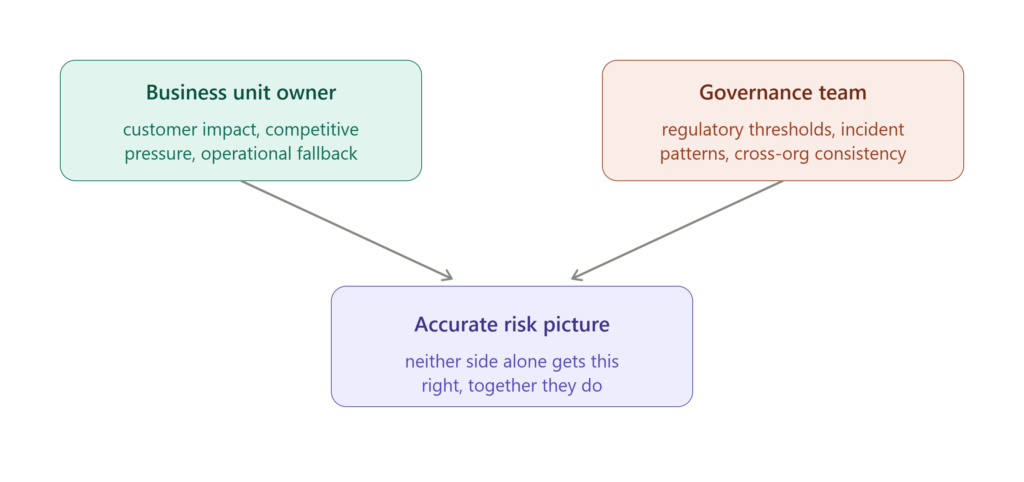
Context refinement works best as a joint exercise. The business unit owner brings knowledge of customer impact, competitive pressure, and operational fallback options. The governance team brings knowledge of regulatory thresholds, prior incident patterns, and cross-organizational consistency. Neither party alone produces an accurate risk picture.
Overcoming Political Friction When Governing AI
This joint ownership model also solves a political problem. When governance rules feel imposed from outside, business units resist them or comply minimally. When business units help define the context variables that determine their own oversight level, they have a stake in the accuracy of that classification — and less incentive to under-report risk just to escape scrutiny.
Where LLM-Based Systems Complicate Context Refinement
Generative AI systems introduce a wrinkle that traditional model governance wasn’t built to handle: the same underlying model can serve wildly different business contexts depending purely on the prompt and the deployment wrapper around it.A single foundation model might power an internal document summarizer, a customer support chatbot, and a code assistant.
That means three distinct risk profiles for just one model.Governance frameworks built around “model-level” review miss this entirely,because a single review at the API-integration stage tells you nothing about what happens when marketing plugs the model into a public-facing tool eighteen months later.
Effective context refinement for generative systems shifts the unit of governance. Instead of the model itself, it focuses on each discrete use case built on top of it. This means tracking every application layer separately— the system prompt, the guardrails, the output validation steps, the audience — even when they all trace back to a shared underlying model. It’s more overhead than governing a single static classifier, but it reflects how these systems actually get deployed inside real organizations.
Measuring Whether Context Refinement Is Working
Governance teams often measure success by counting completed reviews or documented models. Those are activity metrics, not outcome metrics.Teams should judge context refinement against different signals
- Review cycle time relative to risk tier. Low-risk approvals should move in days, not weeks. If everything still takes the same amount of time regardless of tier, the refinement layer isn’t actually changing behavior.
- Shadow deployment rate. Are business units still bypassing the governed pipeline? A drop in undocumented, off-books AI usage is one of the clearest signs that refined governance is perceived as workable rather than obstructive.
- Incident severity distribution. Over time, high-severity incidents should cluster in the tiers that received the most scrutiny, and low-severity tiers should show fewer surprises. If a “low-risk” tier keeps producing serious incidents, the context variables used to assign that tier need revisiting.
- Re-classification frequency. A healthy program sees models moving between tiers as their use case evolves. A static distribution, where nothing ever changes tier, usually means the re-intake trigger isn’t firing when it should.
Practical Starting Point for Teams Building This Now
Organizations that haven’t formalized context refinement yet don’t need a large program to start. A useful first move is auditing the ten or twenty AI systems already in production and asking, for each one, three questions: who is affected if this is wrong, can a human catch the error before it causes harm, and does this touch a regulated decision.Sorting existing systems against just those three questions immediately reveals which ones are under-governed relative to their exposure. It also highlights which low-stakes models are wasting the review board’s time.
From there, the tiering structure, the intake questions, and the re-triggering logic can get built out gradually, informed by what the initial audit actually surfaces rather than copied wholesale from a generic template. Governance that reflects a company’s specific business reality, built from its own data rather than borrowed frameworks, tends to survive contact with actual operational pressure. Governance copied from a template tends to get quietly abandoned the first time it slows down a deadline that matters.
The organizations getting this right aren’t the ones with the thickest policy documents. They’re the ones where the level of scrutiny on any given AI system actually tracks how much damage that system could do — and where that tracking updates as the business itself changes.