
Most companies do not fail with technology because they chose the software. They fail because nobody is paying attention to the infrastructure at 3 a.m. When a disk array starts having problems. This is the problem that data center managed services are trying to solve. It is a bigger problem than most information technology budgets think it is.
Running the infrastructure in house used to be something companies were proud of. Now it is often a problem. Things like replacing hardware making sure we follow the rules and keeping the systems up to date. These tasks just keep piling up until one bad week makes them a big issue. Companies that pay someone to do this work, a managed services provider are not taking the easy way out. They know that taking care of the infrastructure is a job that requires a lot of expertise and their own teams, who have a lot of other things to do just cannot handle it. Data center managed services are the answer, to this problem. Companies need to understand that.
What Data Center Managed Services Actually Cover
People throw around the term “managed services” a lot. Lets break down whats actually included. A good provider handles physical infrastructure monitoring. This means they look at power, cooling, rack density and cabling. They also handle the layer. This includes servers, storage arrays, virtualization hosts, backup systems and network hardware.
Good providers also take care of patch management firmware updates and capacity planning. Many businesses forget about capacity planning. They do not notice storage utilization getting to 85% until something goes wrong. A managed services team checks these trends every week. They do not wait for a problem to happen.
Providers often include security operations as part of managed services. Not always. Some businesses split infrastructure management and security monitoring between two vendors. Data Center Managed Services can work if the two teams communicate well. A common problem, in enterprise IT is when different vendors do not work together well. When looking for a provider it is an idea to ask how they work with your existing security team.
1. Why Modern Data Center Services Matter More Now Than Ever
Infrastructure complexity has not increased in a way. It has grown in layers. A typical mid-size business nowadays runs its workloads on its hardware on at least one public cloud and also on some kind of edge deployment for applications that are sensitive to latency. Each of these environments has its set of tools for monitoring its own schedule for patching and its own ways of failing.
Trying to manage all of this with an internal team of two or three people is a recipe for exhaustion and exhaustion leads to important alerts being missed. If an internal team misses a single alert for a disk failure in a RAID array, the company can lose data within hours if a second drive fails before engineers replace the first one. This is not something that only happens in theory. It actually happens a lot at companies that assume someone will notice something is wrong of putting in place a proper system for monitoring.
Data center managed services help with this problem by spreading the workload across a team that only does this kind of work. The engineers at these services see patterns of failure in hundreds of client environments not just the one they are working on. The ability to recognize these patterns is what they are really selling. It is not about having a certain number of people on staff but, about the knowledge they have gained from doing this work.
2. Core Criteria for Evaluating a Data Center Services Provider
Not all managed services contracts deliver the same value, and pricing alone tells you almost nothing about quality. Here’s what actually separates a strong provider from a mediocre one.
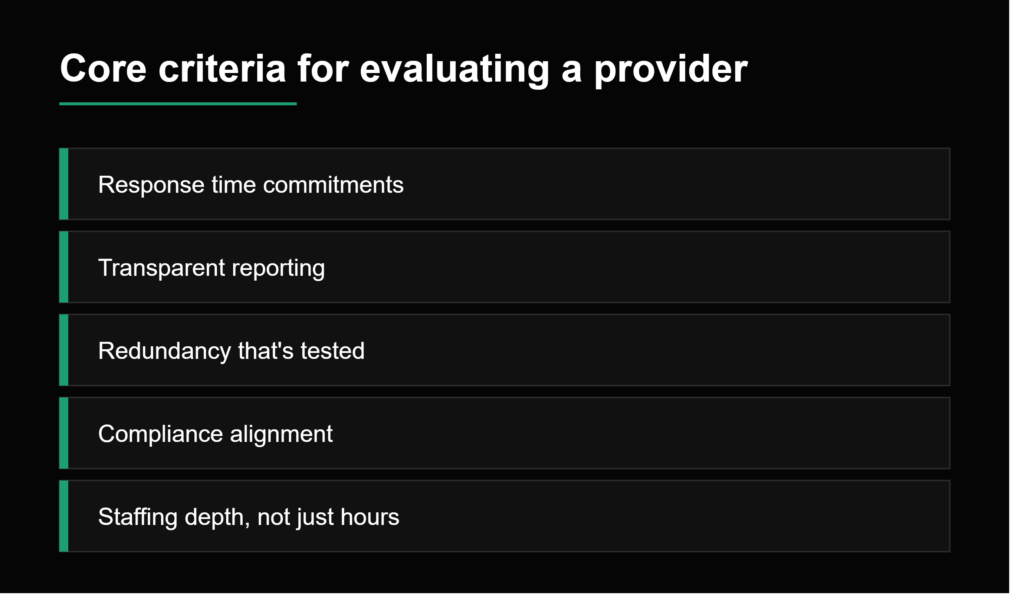
2.1. Response Time Commitments in Managed Services
A provider that promises “24/7 monitoring” without a written agreement that includes a response time for incidents and a penalty for not meeting it is just making an empty claim. You should ask for numbers on how long it takes them to acknowledge and resolve issues from their current clients not just what they say in the contract.
2.2. Transparent Reporting From Your Managed Services Provider
You should be able to see exactly what was fixed when it was fixed and why it was fixed. You should also see what issues were put off and why. If a provider can’t give you a report on what they did each month without you having to ask multiple times that’s a warning sign.
2.3. Tested Redundancy in Data Center Managed Services
not just drawn on a diagram. Anyone can draw a plan for a system on a whiteboard.. Few providers actually test their backup systems and document the results. You should ask when the last test of their system was and what went wrong during the test. If nothing ever went wrong they are probably not testing it enough.
2.4 Compliance Alignment in Managed Services Contracts
A healthcare company needs infrastructure that meets HIPAA requirements. A fintech startup needs providers that understand PCI-DSS and SOC 2 requirements. Generic claims of compliance without specifics usually mean the provider hasn’t actually checked their processes against your environment.
2.5 Staffing Depth, Not Just Staffing Hours
A provider with three engineers covering hundreds of clients and claiming “24/7” coverage is different from one with a team that is properly staffed across time zones. You should ask how many engineers are on duty, during an overnight period not just what hours the phone line is staffed.
3. The Hybrid and Multi-Cloud Reality in Data Center Services
Few businesses today run only on their own servers. Most do not run on one big cloud service either.The truth is that businesses use a mix: some tasks on their special computers for security or speed reasons.
Some tasks are done on cloud services like AWS or Azure because they can easily handle lots of work.Increasingly some tasks are done on computers near where the data is collected like with Internet of Things devices or real-time applications.
Data center managed services creates a problem for managing all these different systems.Tools that help monitor one type of system do not work well with another type.A company that is good at managing its servers will struggle when its tasks need to suddenly use cloud services during busy times.On the hand some cloud service providers are not good at fixing problems, with physical computers when something goes wrong.The companies that do this well have built a system that can see everything:
- physical computers
- virtual machines
- and cloud services.
This is work and it is reasonable to ask any company that provides this service:an you show me one screen that lets your team see everything that is happening across all my systems?Not three separate screens,. One.
4. Cost Structures and What You’re Actually Paying For
Pricing models for managed services are different than what people think. Some companies charge for each device they manage like a server or a switch. They charge for each one. Other companies have levels of service like a gold level or a bronze level. The gold level is really good. Includes planning for the future and checking the system every few months. The bronze level is more basic and just fixes problems when they happen.
One way of doing things is not better than the other Unexpected extra charges often surprise companies.If someone has to work on a problem outside of hours or fix a big issue it can make the monthly bill a lot higher. Before you agree to work with a company make sure you know what is included and what will cost extra. It is also an idea to ask for a reference from another company that has worked with them for a long time. This can tell you if the company is really good at what they do.
There is another cost that people do not always think about. This is the time your team spends dealing with the managed services company. If the company needs a lot of help and attention it can be a problem. Even if the bill from the company is not too high it can still be a deal. The good thing about managed services is that they can help your team by taking care of things they do not have to think about. Managed services are really valuable when they make things easier, for your team.
5. Security as a Non-Negotiable Layer in Infrastructure Services
You can’t really separate infrastructure management and security anymore, even when vendors bill them as distinct services. A managed services provider touching your servers, storage, and network equipment has privileged access that needs the same scrutiny you’d apply to any internal admin account.
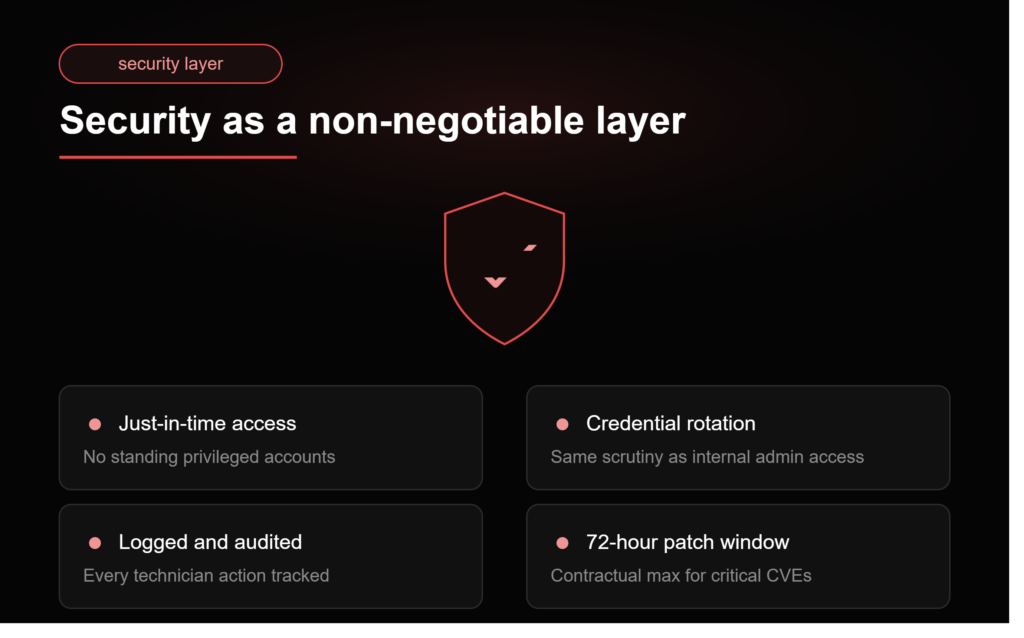
When you are looking for a provider you should ask them about how they handle rotation for their own technicians. Do they use in-time access provisioning or do they use standing privileged accounts? You should also ask them how they log and audit their teams activity within your environment.
If a provider cannot answer these questions clearly that is a problem. It is a security risk no matter how good their infrastructure monitoring looks.
You should also think about patch management timelines. This is important. When there are vulnerability patches the provider should have a plan for how quickly they will deploy them. They should have a deployment window, which is the amount of time they have to deploy the patch. For patches this window should be under 72 hours. This is based on the scoring.
The provider should put this commitment, in the contract not just tell you about it when they are trying to sell you something. This way you can be sure they will actually do what they say they will do.
6. What Seamless Onboarding for Data Center Services Looks Like
When you move to a managed services provider the first few weeks are really important. This is when you start to trust each other or things can go wrong. If the provider just sets up their tools and says they are done that is not a start. They need to take the time to get to know your systems and how they work.
A good provider will do a check of your infrastructure before they start managing it. They will make a list of all your devices what version of software they are running, how they are set up and any problems you already know about. This is important because on if something goes wrong you need to know what changed and what did not. If you do not have a record of how things were set up you will have to start from scratch every time you try to fix a problem.
The first 30 to 60 days, with a provider can be a bit crazy. You will probably get a lot of alerts and warnings about problems that you did not know you had.. This is actually a good thing. It means the providers tools are working well and they are catching small problems before they become big ones. Managed services provider is doing their job. That is what you want. Managed services provider should be able to help you fix these problems and prevent them from happening.
Making the Final Decision on Your Data Center Provider
Choosing a provider is about matching their expertise to your business needs. A small business with a servers doesn’t need as much support as a big company handling financial transactions worldwide. Buying much service for a small setup wastes money. On the hand not buying enough for a business with strict rules can lead to trouble with regulators and damage your reputation if something goes wrong.
When talking to providers ask to speak with their clients not just the ones they recommend. Ask them about how the provider responds when theres a real problem, not just what they would do in theory. Also ask if you can try out their service for a time on some of your systems before committing to a long-term deal. Providers who are confident, in their abilities will agree to this. If they don’t want to that’s a warning sign.