
The artificial intelligence market for businesses is moving really fast.Companies often get stuck between two things: they need to use AI systems away but they also have to follow strict security rules.
Most projects get stuck at this point.Teams make test versions but they do not meet the rules to be used by the whole company.BLDR AI solves this problem.
Operating as a no-code operating system for enterprise AI, BLDR AI transitions abstract ideas into secure, governed production workflows across the entire organization. The platform effectively bridges the gap between raw large language models and legacy infrastructure without requiring multi-month custom software engineering cycles. Consequently, businesses now deploy secure AI systems effortlessly while maintaining absolute control over corporate governance and compliance guidelines.
1. Plain-Language Workflow Orchestration in BLDR AI
Traditional business automation relies on complex code and rigid workflows that often break when business rules change. BLDR AI replaces this with a simple, natural-language approach:
Plain English Prompt ──> BLDR OS Engine ──> Governed Production Workflow
Users simply describe their business processes in everyday language. The BLDR OS Engine automatically interprets these instructions, identifies necessary tasks, sequences actions, and connects the data. When a business rule or regulation changes, a user just updates the text, and the system instantly adapts.
This shifts software creation away from engineers. Now, non-technical team leads and department heads can independently create, manage, and modify workflows—making company automation faster, more flexible, and remarkably easy to maintain.
2. Enterprise Knowledge Grounding: BLDR AI RAG Integration
Raw AI models do not have operational context. For example, they are not aware of your shipping policies, human resources guidelines, or database structures. As a result, they may provide responses that do not match your business needs. Moreover, solving this issue through AI model tuning can be slow, expensive, and difficult to maintain as information changes.
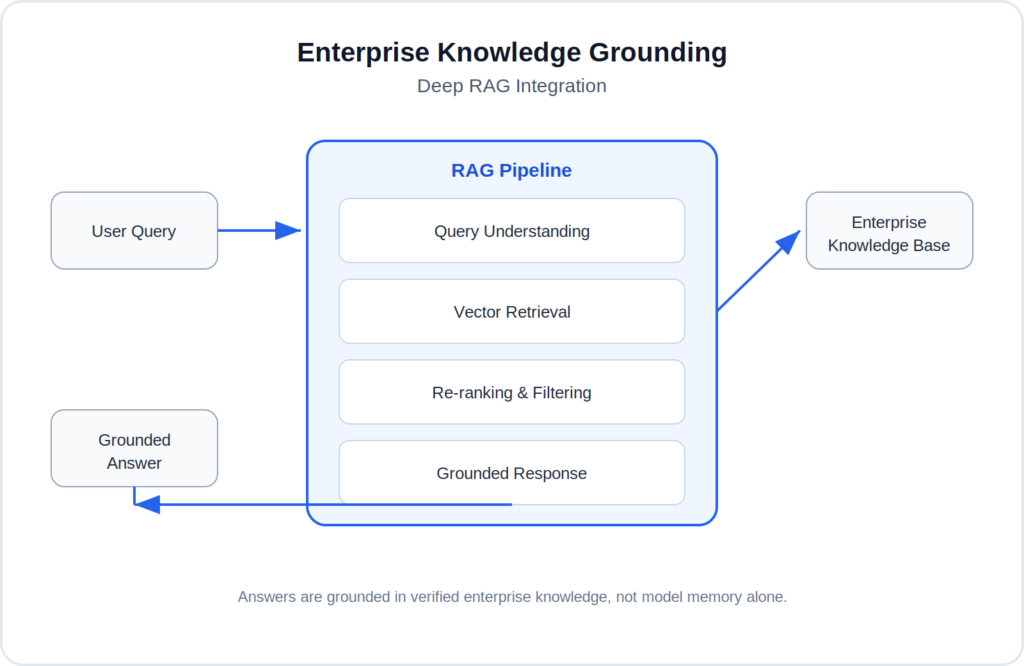
Therefore, BLDR AI uses a Retrieval-Augmented Generation (RAG) architecture to connect AI responses directly to internal data sources. In this way, BLDR AI provides answers based on current business information. Additionally, this approach improves accuracy and helps companies keep their AI systems aligned with their latest data.Raw AI models do not have operational context. For example, they are not aware of your shipping policies, human resources guidelines, or database structures. As a result, they may provide responses that do not match your business needs. Moreover, solving this issue through AI model tuning can be slow, expensive, and difficult to maintain as information changes.
| Data Type | Integration Method | Operational Benefit |
| Unstructured Assets | Native PDF, DOCX, and policy library parsing | Eliminates manual data entry and maintains exact source citations. |
| Legacy Systems | Direct CRM, ERP, and relational database APIs | Connects real-time operational metrics directly to the AI context. |
| Operational Silos | Multi-department document repositories | Unifies fragmented institutional knowledge into a single search fabric. |
- The system looks at different sources at the same time.
- When an agent gets a question the platform searches connected systems to find answers.
- It pulls out pieces of information and shows them to the next step.
- The answers include quotes from where the information came from.
- This helps keep the answers honest and based on facts, from company documents.
- The system prevents made-up answers. Ensures that everything can be checked against existing company info.
3. Policy-Aware Governance: Inside the BLDR AI Security Gateway
Security is still the problem for companies that want to use AI. Employees often send information through public tools that are not monitored which creates big compliance issues. This hidden AI behavior puts company code, customer personal data and financial records at risk.
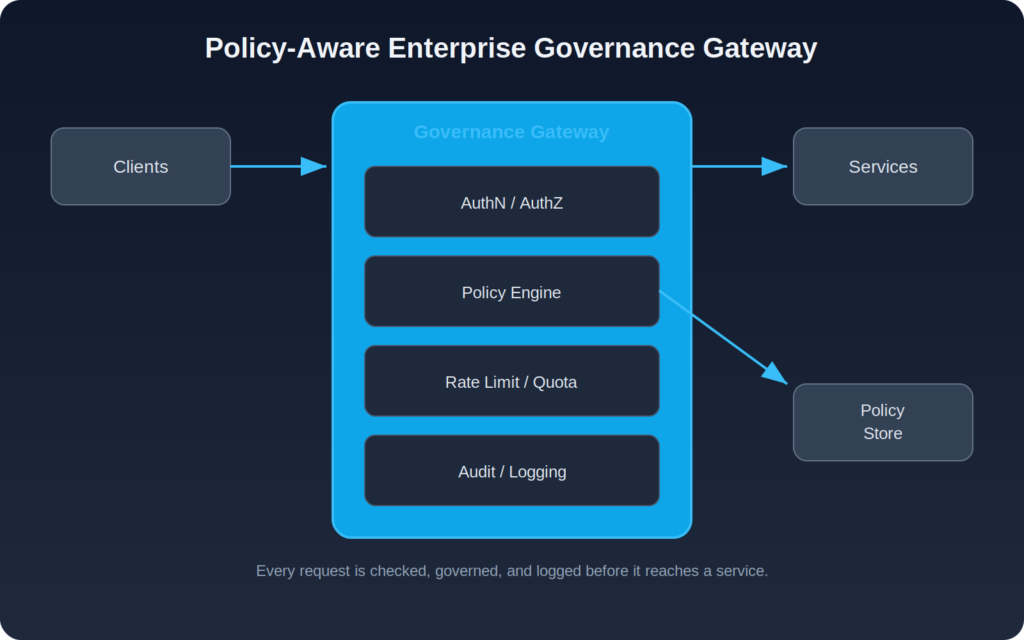
The BLDR AI system is like a controlled gate that sits between users, AI models and company data. It keeps everything secure by following rules:
Policy-Aware Governance: Inside the BLDR AI Security Gateway
Security remains the single largest hurdle preventing corporate AI adoption…
Core Security Mechanics of the Gateway
1. Role-Based Access Control (RBAC): This feature restricts agent capabilities based on an employee’s specific organizational clearance, ensuring a new hire never accesses executive compensation files.
2. Automated Data Masking: The gateway identifies and strips personally identifiable information (PII) before queries leave the secure corporate network.
3. Real-Time Policy Inspection: The system evaluates outbound tool actions against strict business rules before execution occurs.
4. Immutable Audit Trail: The platform logs every interaction, system call, and manual approval step into an unalterable history log
Every interaction system call and approval step is. Cannot be changed. This gives compliance teams a view of whats happening making it easier to pass external regulatory audits. The BLDR Security Gateway helps prevent shadow AI behavior by keeping everything secure and, under control. BLDR AI and BLDR Security Gateway work together to protect company data.Security is still the problem for companies that want to use AI. Employees often send information through public tools that are not monitored which creates big compliance issues. This hidden AI behavior puts company code, customer personal data and financial records at risk.
4. Multi-Model Routing and Infrastructure Abstraction
Relying on a single AI provider can put your business at risk due to changing costs, performance issues, or service outages. BLDR AI solves this by separating business workflows from AI models. It continuously monitors performance, cost, and response time, routing complex tasks to advanced AI models and simpler tasks to efficient local models. This approach lowers costs, reduces maintenance, and keeps your business running even if cloud AI services experience outages.Relying on a single AI provider can put your business at risk due to changing costs, performance issues, or service outages. BLDR AI solves this by separating business workflows from AI models. It continuously monitors performance, cost, and response time, routing complex tasks to advanced AI models and simpler tasks to efficient local models. This approach lowers costs, reduces maintenance, and keeps your business running even if cloud AI services experience outages.
5. Human-in-the-Loop Remediation Systems
Complete automation can be bad in areas like finance, healthcare or big companies where rules are strict. When machines make all the decisions mistakes can happen. BLDR AI solves this by letting people step in when needed.
- Workflows work on their own until they reach a risk level.
- If something strange happens, like a conflict or a big transaction, the system. Asks a person for help.
- It shows the person what happened and waits for them to say it’s okay.
- When the person agrees the workflow starts again.
- This way automation is fast. People are still, in charge.
6. Measurable Operational Performance Metrics with BLDR AI
Using technology without a way to track what is happening is a waste of time. BLDR AI gives us a view of what is going on with its direct telemetry dashboards. These dashboards show us how things are working across our production workflows. Companies that use the platform see improvements in a short amount of time across different departments.
1. HR and Onboarding Automation
When we execute onboarding manually, it typically consumes hundreds of hours for administrators. Fortunately, the system resolves this inefficiency by giving employees instant access to our policy libraries. Consequently, the platform resolves up to 42% of routine employee inquiries immediately. New hires retrieve precise details without waiting; however, if a scenario is unique, the engine automatically routes it to an HR professional.
2. Technical Support Operations
Sometimes internal IT helpdesks get completely overwhelmed with repetitive requests like password resets. To solve this, the platform analyzes the internal knowledge base to diagnose the problem and suggest an immediate fix. Furthermore, it can even execute the remediation automatically while maintaining human oversight. As a result, this intelligent automation reduces overall resolution times by an average of 35%.
3. Compliance Verification
When teams perform audits manually, there is always a high chance that critical data can be missed. Therefore, the system eliminates this risk by routing every single workflow through a strict governance layer. This means that every transaction and data access request gets permanently logged. In addition, this log cannot be changed, ensuring you remain compliant at all times.We can always go back. Check the logs to make sure everything is okay. BLDR AI and its platform are very helpful, in making sure that our workflows are running smoothly and that we are complying with rules.
7. Implementation Methodology
When you are moving from an AI environment to a centralized system you need to do things in a very organized way. The platform helps you do this by breaking it down into five steps:
- Process Mapping: First, users write down how they want things to work in a way that’s easy to understand. Subsequently, the system takes this information and automatically creates the basic rules.
- Knowledge Grounding: Next, the people in charge find all the documents, links to cloud storage, and databases. Therefore, they can connect them to the active workflow easily.
- Integration Wiring: In addition, technical teams connect external tools, special connections, and legacy software to the platform capabilities seamlessly.
- Governance Modeling: Furthermore, security officers decide access permissions and set up rules for when things need approval to keep information hidden.
- Production Rollout: Finally, the system puts the workflow into action. As a result, users track how well it works by looking at dashboards that show latency, accuracy, and cost metrics in real time.
8. Securing the Next Generation of Operational Workflows with BLDR AI
Deploying enterprise AI does not mean choosing between speed and security. Businesses can achieve both. BLDR AI enables companies to use language models securely by integrating security controls and human oversight from the start.
Using natural language instead of complex code simplifies automation and speeds up development. BLDR AI adapts to changing business needs while protecting company data. This approach helps teams reduce delays, build scalable systems, and continue innovating without rebuilding their infrastructure.