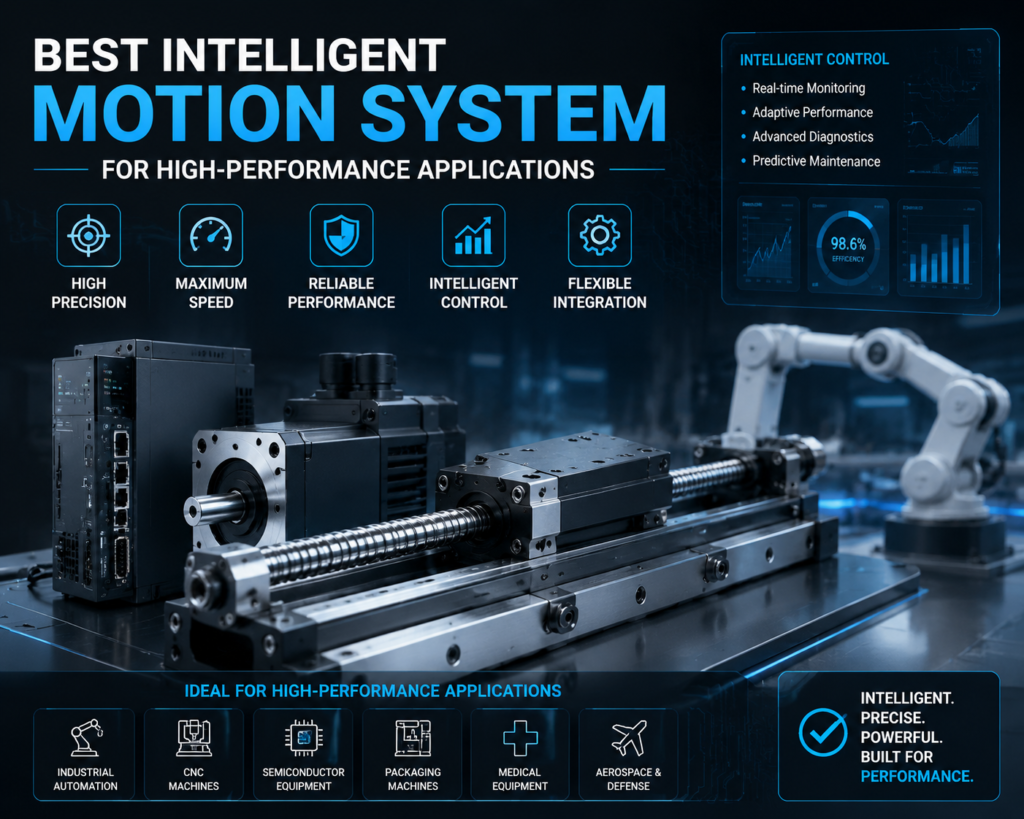

I got asked this question three times last month by three different engineers, and I gave three different answers. That’s the honest starting point for anything about an intelligent motion system: there’s no single “best” one — there’s a right one for your torque requirements, your latency budget, and — let’s be real — your maintenance team’s patience. Every vendor pitch makes their intelligent motion system sound like the universal answer. It isn’t.
Here’s what I mean. A packaging line running at 400 cycles a minute doesn’t need the same brain as a surgical robot threading a catheter. Both count as “high-performance.” Both technically qualify for an intelligent motion system. But if you tried to swap their controllers, you’d have a very expensive problem on your hands .So let’s actually walk through what’s out there right now, what’s changed in the last eighteen months, and where I think the hype outruns the hardware.
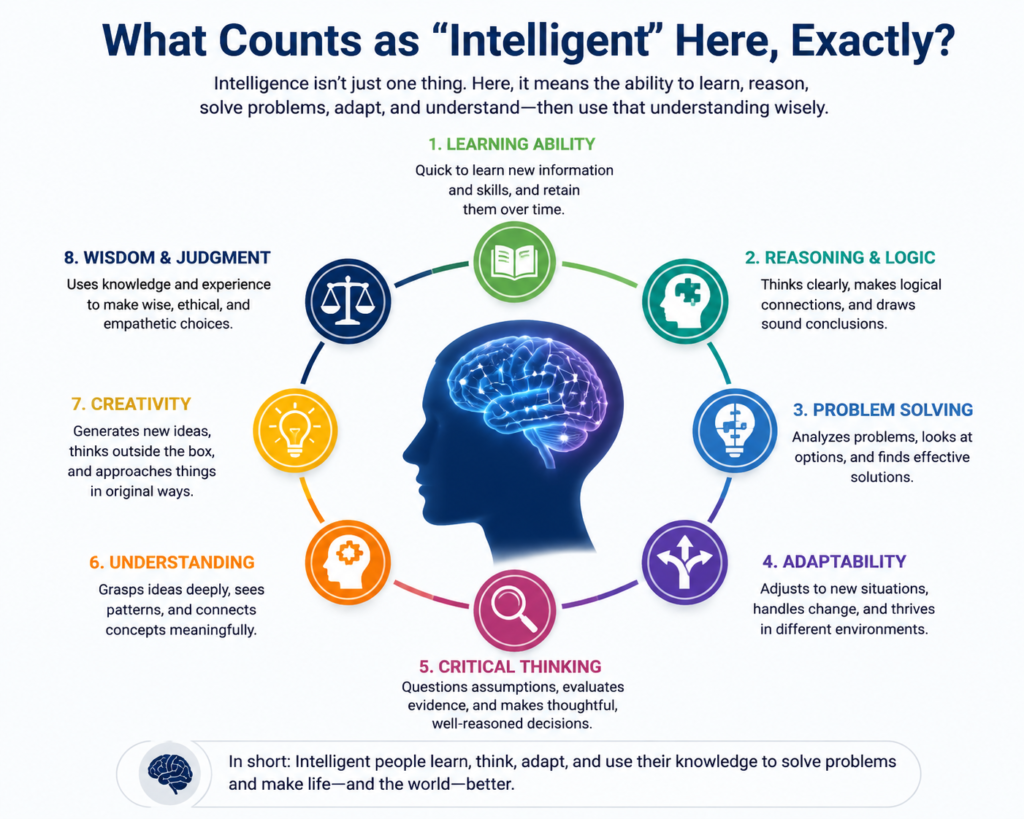
What Counts as “Intelligent” Here, Exactly?
Quick definition, because the term gets thrown around loosely. A traditional motion controller runs pre-programmed trajectories — you tell it where to go, how fast, and it goes. An intelligent motion system adds a feedback loop that adapts the trajectory in real time, usually based on sensor data, machine learning models, or both. Think servo drives that adjust cutting parameters mid-cycle instead of finishing a bad pass and fixing it later.
Siemens did exactly this with its SIMOTION D435-2 platform, which pushed edge AI down onto the drive itself so CNC operators could adapt cutting parameters on the fly, without stopping the line to recalibrate. That’s a genuinely useful shift — it’s the difference between “smart” as a marketing word and “smart” as an engineering property.
Market Landscape: It’s Bigger and Messier Than You’d Think
The numbers here vary a lot depending on who’s counting and what they’re bundling in, which tells you the category itself is still settling. Some analysts peg the broader motion control market around $15–18 billion in 2025, on track to roughly double by the mid-2030s. Others focused specifically on intelligent motion control systems put 2024 at closer to $5 billion, growing faster — north of 9% CAGR — because it’s coming off a smaller base and riding the AI wave harder than the legacy segment.
What’s consistent across basically every report I looked at: closed-loop systems dominate (somewhere around 46–52% share), Asia Pacific is the growth engine — China’s machinery sector alone is generating something like a trillion dollars a year — and the “controllers” sub-segment is growing faster than motors or drives. Translation: the differentiation is moving up the stack, from raw mechanics into software and edge intelligence.
Key Trends & Innovations Worth Watching
A few things are actually moving the needle, not just filling slide decks:
- Edge AI on the drive itself. Instead of sending sensor data up to a central controller and waiting for a response, the intelligence lives right at the servo drive. Lower latency, and honestly, fewer points of failure.
- Sensor fusion for cobots. Universal Robots and Fanuc have leaned hard into this — blending vision, force feedback, and proximity sensing so a robot arm can work next to a human without a safety cage. That’s not a small engineering feat.
- Predictive maintenance baked in. AI models trained on vibration and thermal data now flag bearing wear before it becomes a failure. I’ve talked to plant managers who say this alone paid for the upgrade within a year.
- Cloud-plus-edge hybrid architectures. Rockwell’s partnership with Microsoft is a good example — heavy model training happens in the cloud, but the actual control loop stays local, because nobody wants a robot arm waiting on an internet connection to decide whether to stop.
Traditional vs. AI-Only vs. Hybrid: The Real Trade-offs
This is the comparison that actually matters when you’re specifying a system, not just reading about one.
| Factor | Traditional Motion Control | AI-Only Motion System | Hybrid Intelligent Motion System |
|---|---|---|---|
| Trajectory adaptation | Fixed, pre-programmed | Fully learned, adapts continuously | Rule-based core with AI-driven adjustment layer |
| Latency | Very low, deterministic | Can be variable depending on model complexity | Low — critical loop stays local, AI runs at the edge |
| Setup & tuning time | Long, manual | Faster initial setup, but needs training data | Moderate — leverages known baselines, refines with data |
| Failure predictability | High (but reactive, not predictive) | Lower predictability, harder to certify | Predictive maintenance with fallback to deterministic control |
| Cost of entry | Lowest | Highest (data, compute, expertise) | Mid-range, scales with deployment |
| Best fit | Repetitive, unchanging tasks | R&D, highly variable environments | Most real-world industrial and robotics applications |
If I’m being blunt — and I usually am about this — the “AI-only” column is mostly a research narrative right now, not a production reality for safety-critical, high-speed work. The hybrid model wins in practically every serious deployment I’ve come across, because it keeps a deterministic safety net under the adaptive layer. You want the learning system suggesting improvements, not making the final call on whether a robot arm stops in 8 milliseconds or not.
Business Opportunities and the Honest Challenges
The opportunity side is obvious: pharma and life sciences are modernizing fill-finish lines to meet updated FDA sterility guidance, and that’s driving real budget toward hygienic, servo-electric systems with redundant feedback loops. Semiconductor fabs are pouring money into wafer-handling precision as domestic chip manufacturing ramps up in the US. Automakers are swapping hydraulic presses for servo-electric units to hit lightweighting and energy targets on EV lines.
But — and this is the part vendors gloss over — the barriers are real. Japanese manufacturers alone can put a new supplier through 12 to 18 months of qualification testing before anything ships. Integrating an AI layer into a certified safety system means re-certifying, which isn’t cheap or fast. And there’s a legitimate skeptical camp here worth naming: several automation engineers I’ve spoken with argue that “AI-enabled” is being stapled onto products that were already going to ship a firmware update, just to justify a price bump. That criticism isn’t wrong every time. Ask your vendor exactly what the AI layer changes about closed-loop response time — if they can’t answer specifically, be suspicious.
Future Outlook
Where this goes next, in my read: less emphasis on “AI-only” hero products, more emphasis on quietly embedding intelligence into components that already work — drives, controllers, feedback sensors — so the upgrade path doesn’t require ripping out a certified line. Intel’s Robotics AI Suite, launched in October 2025, is a signal of that direction — reference hardware and software meant to shorten the pilot-to-production gap rather than reinvent the control loop from scratch.
Expect edge AI to keep creeping down into cheaper hardware too. What required a $50,000 controller two years ago is increasingly available in mid-tier servo drives, which is going to matter a lot for small and mid-sized manufacturers who got priced out of “intelligent” the first time around.
Wrapping Up
The best intelligent motion system isn’t a specific product — it’s the one that matches your latency tolerance, your certification requirements, and how much unpredictability your application actually has to absorb. For most high-performance industrial and robotics work in 2026, that points toward a hybrid architecture: deterministic control where safety demands it, AI-driven adaptation where it earns its keep.
What’s your setup dealing with right now — is it a latency problem, a maintenance problem, or a “the line changes too often to hard-code” problem? Drop it in the comments, or if you’re mid-evaluation, I’d genuinely like to hear which vendors made your shortlist and why.
Suggested internal linking anchor text ideas:
- “how servo drives handle real-time feedback loops”
- “choosing between closed-loop and open-loop control for your application”
- “predictive maintenance ROI in industrial automation”
Suggested authoritative external sources to link:

- International Federation of Robotics (ifr.org) — global industrial robot installation data
- Siemens SIMATIC Motion Control / TIA Portal documentation
- Mordor Intelligence motion control market reports
- Grand View Research — AI in Robotics market report
FAQs
It’s a motion control setup — motors, drives, controllers, feedback sensors — that adjusts its own trajectory in real time based on sensor data or a trained model, instead of just executing a fixed, pre-programmed path.
Not entirely, no. Most production systems today are hybrid — a deterministic control core handles the safety-critical loop, and an AI layer sits on top to optimize, predict wear, or adapt to changing conditions. Pure AI-only control is still mostly confined to R&D and low-risk environments.
It varies a lot by scale, but the honest answer is: less than it used to. Edge AI capability that needed a $50,000 controller two years ago is now showing up in mid-tier servo drives, so smaller manufacturers aren’t
It can, if it’s implemented badly — running the whole decision loop through a cloud model, for instance. Well-designed hybrid systems keep the safety-critical control loop local and deterministic, and let the AI layer work at the edge, so latency stays low.
Semiconductor fabs, pharma and life sciences fill-finish lines, automotive EV assembly, and collaborative robotics (cobots) are leading right now — mostly because precision, uptime, or safety-around-humans directly affects their bottom line.
Conclusion
The best intelligent motion system isn’t a specific product — it’s the one that matches your latency tolerance, your certification requirements, and how much unpredictability your application actually has to absorb.
For most high-performance industrial and robotics work in 2026, that points toward a hybrid architecture: deterministic control where safety demands it, AI-driven adaptation where it earns its keep.
What’s your setup dealing with right now — is it a latency problem, a maintenance problem, or a “the line changes too often to hard-code” problem? Drop it in the comments, or if you’re mid-evaluation, I’d genuinely like to hear which vendors made your shortlist and why.