
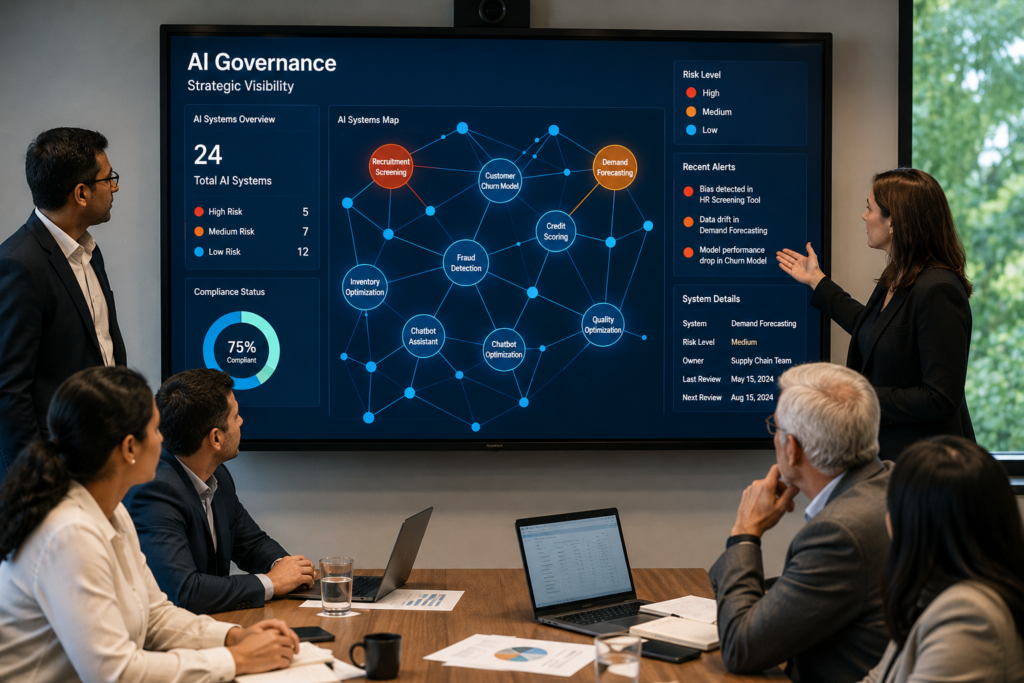
I sat in on a governance-committee dry run last spring where the CIO pulled up a slide titled “Our AI Inventory.” It had 40 systems on it. When the audit team ran a shadow-IT scan two weeks later, they found 340. That gap — between what leadership thinks it’s overseeing and what’s actually running in production — is basically the whole story of AI governance strategic visibility in one anecdote .It’s not a compliance buzzword. It’s the difference between a board that can answer “what could go wrong and where” and one that’s guessing.AI governance strategic visibility is the gap costing boards real money. Here’s what the 2026 data shows, who’s fixing it, and what to do next
AI Governance Strategic Visibility Guide.
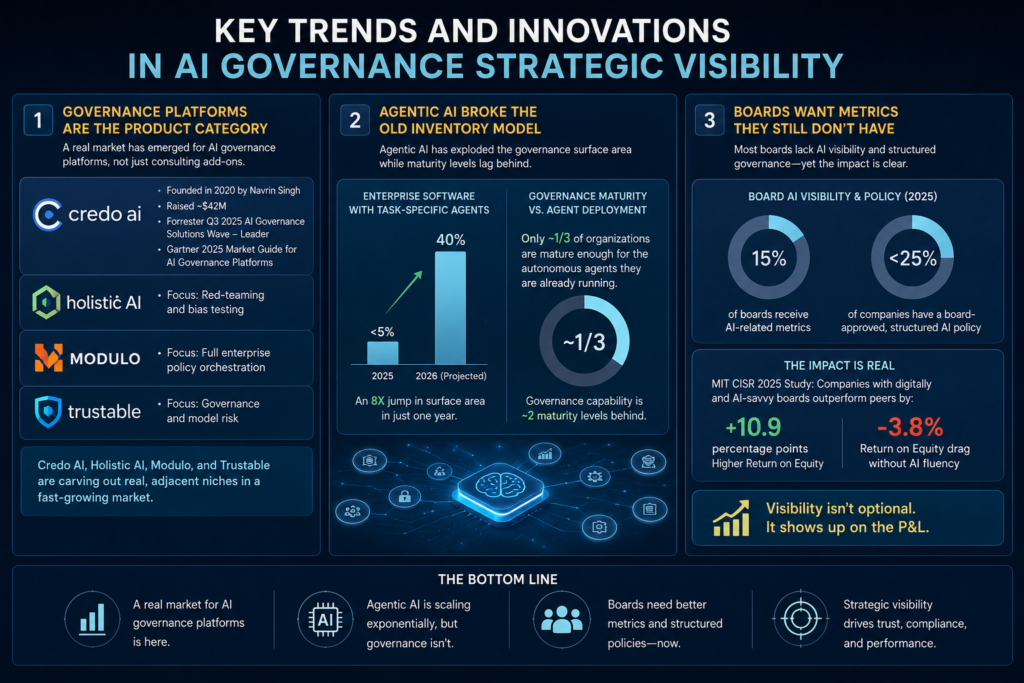
Most companies don’t have that. A December 2025 McKinsey report found that 88% of organizations report using AI in at least one business function, while only 39% of Fortune 100 companies disclosed any form of board oversight of AI.
Nine in ten companies are running AI somewhere. Fewer than four in ten boards can point to a formal mechanism for watching it .And it’s not just a board-level blind spot. The same research found that 66% of directors report “limited to no knowledge or experience” with AI, and nearly a third say AI doesn’t even make their meeting agenda. I’ve sat through board prep decks where “AI risk” gets one bullet point wedged between cybersecurity and supply chain — as if it’s a subcategory instead of the thing touching both.
Market Landscape: Traditional EA vs. AI-Only Tools vs. Hybrid Governance
Here’s where it gets interesting from a buyer’s-market standpoint. For years, enterprise architecture (EA) teams owned “system visibility” through spreadsheets, CMDBs, and periodic audits. That model wasn’t built for something that spins up a new model endpoint every time a product manager tries a new API key.
| Dimension | Traditional EA-Led Governance | AI-Only Governance Tool | Hybrid Model |
|---|---|---|---|
| Discovery speed | Manual, quarterly reviews | Real-time, automated scans | Continuous scan + human triage |
| Regulatory mapping | Generic compliance frameworks | Built-in EU AI Act, ISO 42001 mapping | Automated mapping, human sign-off |
| Board reporting | Static slide decks | Metrics dashboards, low context | Contextualized reporting with narrative |
| Shadow AI detection | Rarely catches it | Strong — this is the core use case | Strong, with ownership assigned |
| Cost of ownership | Low tooling, high labor | Higher tooling, lower labor | Balanced — tooling plus a lean team |
| Best fit | Small, low-AI-maturity orgs | Fast-scaling tech companies | Regulated, multi-business-unit enterprises |
If I’m honest, I think most vendors overstate what “AI-only” tooling can do without a human governance layer sitting on top. A tool that flags 340 shadow systems is useless if nobody’s assigned to triage them. That’s the hybrid model’s whole pitch, and it’s why it’s winning enterprise deals right now.
Key Trends and Innovations
A few things are genuinely shifting the ground here, not just marketing noise.
Ai-governance-strategic-visibility Governance platforms are becoming the actual product category. Credo AI, founded by Navrin Singh in 2020, has raised roughly $42 million and was named a Leader in Forrester’s Q3 2025 AI Governance Solutions Wave, alongside recognition in Gartner’s 2025 Market Guide for AI Governance Platforms. Competitors like Holistic AI, Modulo, and Trustable are carving out adjacent niches — Holistic AI leans harder into red-teaming and bias testing, while Credo AI and Modulo push toward full enterprise policy orchestration. That’s a real market now, not a research project a few consultancies bolted onto their risk practice
Business Opportunities and Challenges
There’s real money on both sides of this. For vendors, the opportunity is obvious — enterprises with high-risk Annex III systems under the EU AI Act face a hard deadline (currently pegged at December 2, 2027, pending the Omnibus deal’s formal adoption), and nobody wants to build compliance tooling in-house from scratch when a platform already maps to ISO/IEC 42001 and the NIST AI RMF out of the box. For enterprises themselves, though, the challenge is less about buying a tool and more about organizational will.
Future Outlook
.Here is what I expect to happen over the 18 months:
- Governance platforms will consolidate. There are many point solutions competing for the same budget from big companies.
- Not all of them will survive.
- Companies will look for board members who’re knowledgeable about AI. This will become a requirement just like having an expert on the audit committee.
- A mid-size company will suffer a problem due, to ungoverned AI. This will make headlines. Make companies realize that AI governance is not just a nice thing to have but a must-have
“Achieving true AI Governance Strategic Visibility is no longer optional for modern enterprises.”.
Wrapping Up
The gap between what leadership believes it can see and what’s actually running is the real governance risk right now — bigger than any single regulation. Strategic visibility isn’t a compliance checkbox; it’s the precondition for every other AI decision a board makes. So here’s my question for you: if someone asked your leadership team right now how many AI systems are live across your company, would the answer be a confident number — or a guess? If you’re wrestling with this at your own organization, I’d genuinely like to hear how you’re approaching it — drop a comment, or if you’re further along than most, tell me what convinced your board to finally take it seriously.