
Introduction
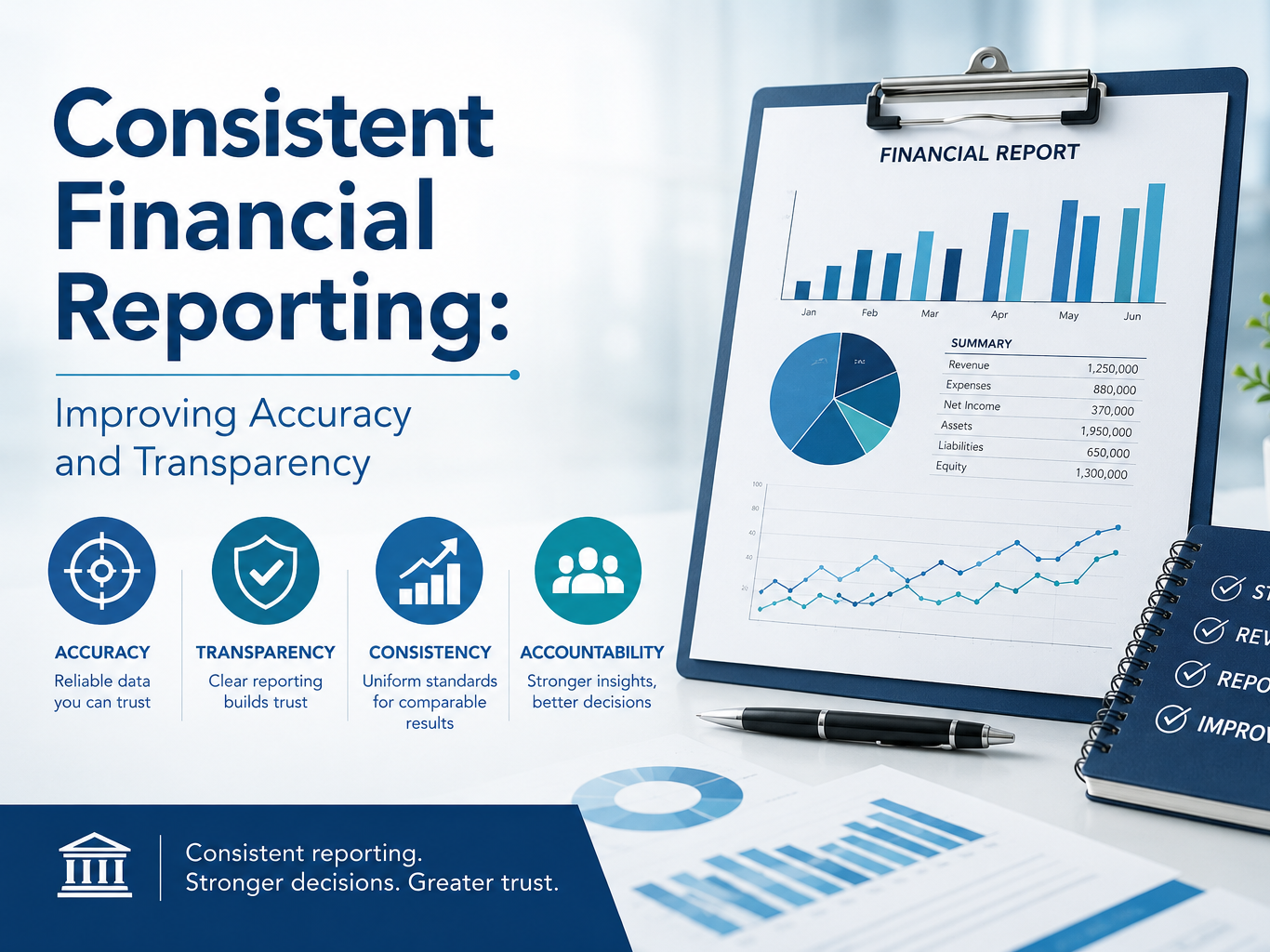
Consistent financial Reporting is not just an ordinary process. Financial reporting is how the company communicates its financial position to its owners, investors, lenders, regulatory authorities, and other stakeholders. In case of inconsistent, untimely or different reports monthly, even a profit-making firm can make wrong decisions.
The use of consistent financial reporting will provide a solid ground for improved planning, compliance, and trust in the organization. Consistency will ensure that the financial information is prepared according to the same standards, procedures, definitions and deadlines every time. No matter what kind of organization you have, whether small or big, you can benefit from increased consistency in your organization.
What Is Consistent Financial Reporting?
Consistency in financial reporting requires the use of identical accounting procedures, presentation formats, policies, and procedures throughout an accounting period. The reader can compare results from previous accounting periods without encountering any difficulties in such financial statements.
For instance, if a company recognizes revenues on invoices in January and recognizes revenues on receipts in June, the financial reports will not be comparable despite the business performance remaining unchanged. Figures will differ although business operations will remain the same. According to the IFRS Conceptual Framework, consistency is the application of identical procedures for identical items throughout the reporting periods. Consistency ensures the ability to make comparisons, which enables the analysis of similarities and differences in financial information.
In general, consistent financial reporting can provide answers to the following questions:
- Is the company’s financial position increasing or decreasing?
- Do costs increase quicker than revenues?
- Is there an improvement in the cash flows?
- Is financial reporting conducted properly?
- Are the figures trustworthy?
Why Consistent Financial Reporting is Important?
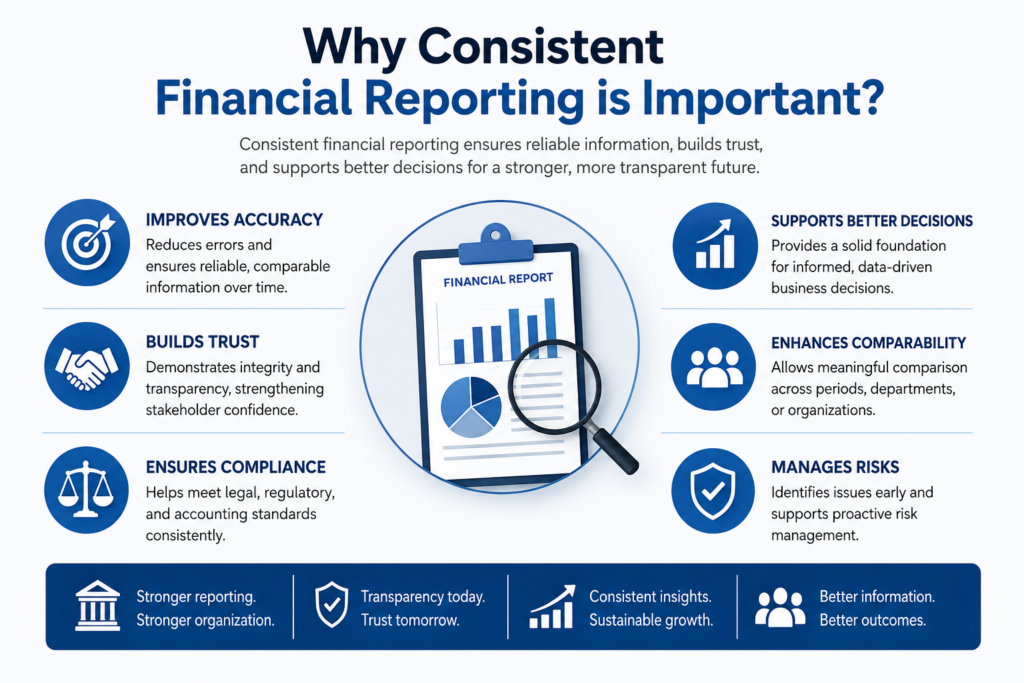
It is crucial to have accurate financial reports, but that is not sufficient. A report can contain accurate information, yet still be inconsistent in terms of reporting method each period. Consistency in reporting provides better insights into the performance of a business.
1.Better Decision-Making
Financial reports are necessary in order for managers to make decisions concerning staffing, pricing, inventory, growth, investments, and cost control. If there is inconsistency in financial data, managers might take decisions based on inaccurate trends.
For instance, suppose a firm alters its policy regarding accounting for marketing costs. One month, marketing costs will be accounted for under “Sales Expenses,” while the other month under “General Administrative Expenses.” The sum total of costs may be accurate, but the manager cannot determine the effectiveness of marketing.
Consistency in chart of accounts and reporting will help establish trends.
2. Increase Trust from Investors/Lenders
When providing financial information, investors/lenders wish to be able to analyze such information in the context of time. They need assurance that revenue, expenses, assets, liabilities, and cash flows are calculated in a reliable way.
If financial reports are consistent, it is possible to analyze company’s performance better and
2.1 Promotes Efficiency
Consistent processes enhance efficiency. Consistency in accounting helps to develop efficient systems for the organization’s growth since it avoids waste of resources in preparing financial reports.
3.Enhances Transparency
Transparency can be defined as provision of financial information in clear form. This does not imply disclosure of all internal information, but giving an unbiased view of the financial situation of the firm.
Consistency in accounting creates the element of transparency through reducing surprises. In case there are changes in accounting policies, the firm should explain the reasons for changes.
IFRS Foundation is an organization that develops international accounting standards intended to improve transparency, accountability, and comparability of capital markets.
4. Reduces Risks of Mistakes and Fraud
There are numerous possibilities of making mistakes in the presence of inconsistent reporting methods. These mistakes come as a result of use of various spreadsheet, various accounts and different formula. In case of consistent reporting process, unusual events will be easily detected. For example, abnormal increase in payroll cost by 40% within one month. As per U.S. Securities and Exchange Commission, internal control over financial reporting leads to material and accurate financial statements.
Key Elements of Consistent Financial Reporting
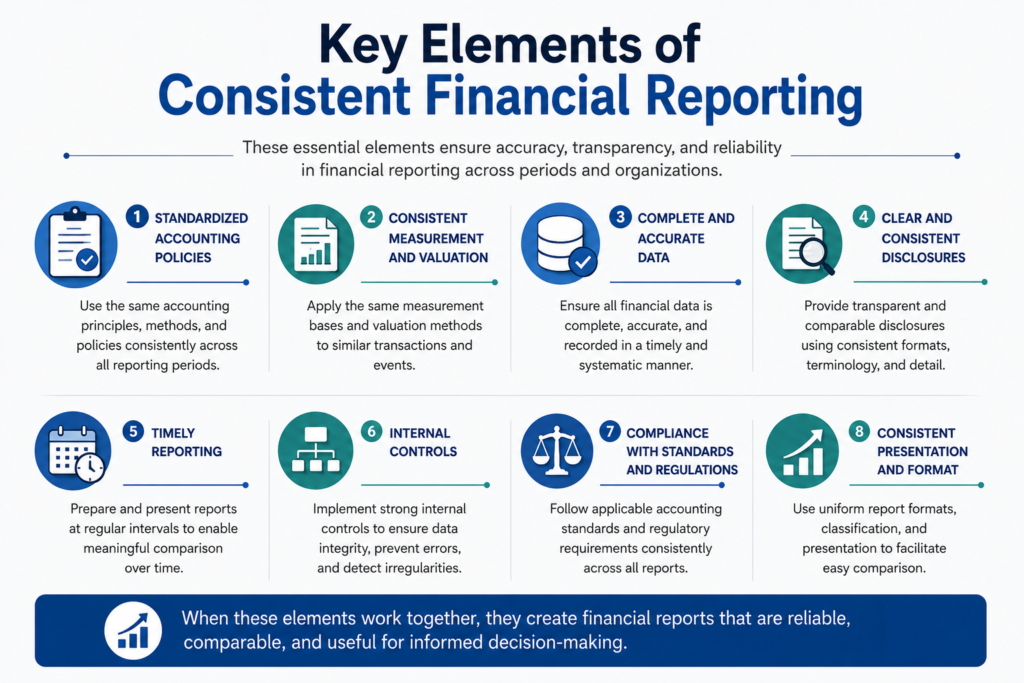
Building consistency requires more than using accounting software. It requires clear policies, reliable controls, and accountability across the organization.
Standardized Accounting Policies
Every business should document its accounting policies. These policies explain how the company handles important financial activities, including:
- Revenue recognition
- Expense recognition
- Inventory valuation
- Depreciation methods
- Accounts receivable
- Bad debt allowances
- Asset capitalization
- Tax reporting
- Foreign currency transactions
When these policies are documented, finance teams can apply the same approach every reporting period.
A Consistent Chart of Accounts
A chart of accounts is the structure used to classify financial transactions. It includes categories such as revenue, payroll, rent, inventory, marketing, assets, liabilities, and equity.
A well-organized chart of accounts prevents confusion and makes reports easier to compare. Avoid creating unnecessary new accounts every month unless there is a clear reporting need.
For example, instead of using separate accounts for every small advertising platform, a business may use one “Digital Advertising” account and track platform details through subcategories.
Reliable Closing Procedures
The month-end close is one of the most important parts of consistent financial reporting. A weak closing process can lead to late reports, missing transactions, and rushed adjustments.
A strong monthly close process should include:
- Reconciling bank accounts.
- Reviewing accounts receivable and accounts payable.
- Recording depreciation and accruals.
- Checking payroll and tax entries.
- Reviewing unusual transactions.
- Comparing actual results with budgets.
- Approving final financial statements.
Using a checklist helps ensure that no important step is missed.
Internal Controls and Review Processes
Internal controls are procedures designed to protect financial data and reduce the risk of errors or misconduct.
Examples of useful controls include:
- Separating payment approval duties from payment processing duties.
- Requiring management approval for large expenses.
- Limiting access to accounting software.
- Reconciling bank accounts regularly.
- Reviewing journal entries before posting.
- Tracking changes to financial reports.
Internal Controls and Review Processes
Internal controls are procedures designed to protect financial data and reduce the risk of errors or misconduct.
Examples of useful controls include:
- Separating payment approval duties from payment processing duties.
- Requiring management approval for large expenses.
- Limiting access to accounting software.
- Reconciling bank accounts regularly.
- Reviewing journal entries before posting.
- Tracking changes to financial reports.
For public companies, internal control over financial reporting is especially important. SEC rules require management to assess the effectiveness of internal controls and identify the framework used for that assessment.
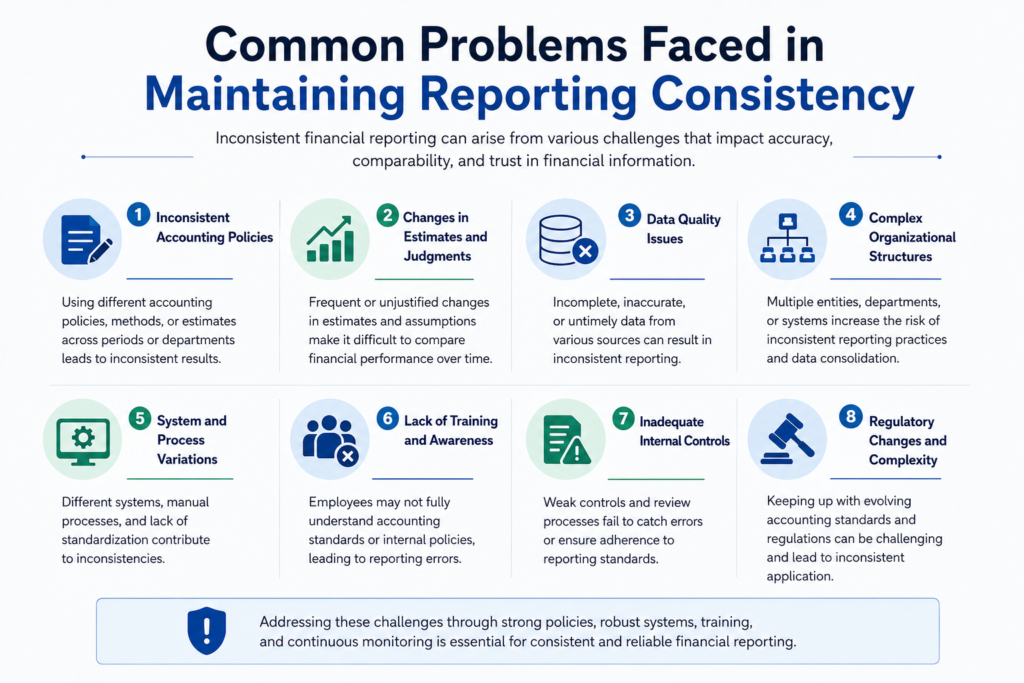
Common Problems Faced in Maintaining Reporting Consistency
There are a number of firms that know the importance of financial reporting but fail to keep it consistent due to certain problems. These problems include ineffective documentation, obsolete systems, lack of employee training, and fast expansion of businesses.
Manual Spread Sheets
The use of spread sheets is helpful; however, when a firm uses a number of manual spread sheets then there is a danger of inconsistency in versions.
This problem can be resolved by storing financial information in one place and establishing policies regarding report editing.
There are a number of firms that know the importance of financial reporting but fail to keep it consistent due to certain problems. These problems include ineffective documentation, obsolete systems, lack of employee training, and fast expansion of businesses.
Best Practices for Improving Financial Reporting Accuracy
Here are practical ways to improve consistent financial reporting in any organization.
- Create written accounting policies and review them annually.
- Use cloud accounting software with access controls.
- Maintain one standardized chart of accounts.
- Close the books on the same schedule every month.
- Reconcile all key accounts regularly.
- Train finance staff on reporting procedures.
- Use dashboards to monitor key financial metrics.
- Compare current results with prior periods and budgets.
- Investigate major variances before publishing reports.
- Document all adjustments and policy changes.
A useful rule is this: if another qualified finance professional cannot understand how a number was calculated, the reporting process needs improvement.
Case Study: Importance of Comparability
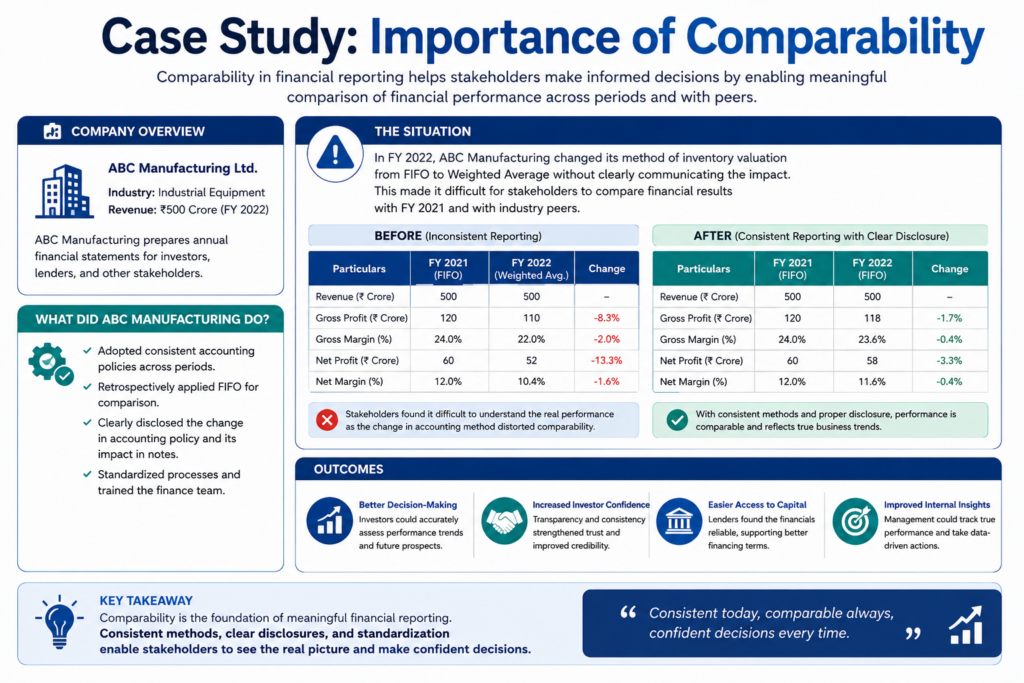
Imagine that there are two retail organizations having comparable annual revenues. Company A uses the same accounting procedures for inventory calculation each year and analyzes its financial statements on a monthly basis. On the other hand, Company B changes the assumptions regarding inventory regularly and postpones reconciliations.
Though both organizations provide information about the same income, the one which provides its calculations regularly gains greater credibility from its investors and lenders.
That is why the principle of consistency cannot be considered as the same process repeated over and over again. The company may change its procedures, however, it should explain these changes.
Conclusion
Financial reporting consistency is not only a matter of regulation. This is an extremely useful business tool that helps to enhance accuracy, transparency, planning, and trust.
When you have well-established practices, solid controls, well-prepared documents, and timely reviews, you make good decisions and establish strong relationships with stakeholders.
First of all, it is necessary to analyze your existing financial reporting system. Try to find the weaknesses in the process, define accounting policies, and develop a monthly close checklist. Even small changes may result in improved financial reporting in the future.
FAQs
1.Consistent Financial Reporting – What Is It?
Consistent financial reporting is when a company prepares its financial statements using similar accounting procedures, policies, formats, and scheduling. Consistency in financial reporting helps businesses to make comparisons between different reporting periods.
2.The Importance of Consistent Financial Reporting
Consistent financial reporting enhances the quality of information that is prepared for decision making, increases transparency, and makes the process less prone to errors.
3.What can a business do to enhance consistency in its financial reporting?
To enhance consistency, a company should apply a standard chart of accounts, record its accounting policies, maintain a monthly closing schedule, perform account reconciliation, and check the reports prior to their issuance.
4.What are the major advantages of consistent financial reporting?
Advantages include proper decision making, financial statement analysis, increased compliance, effective internal control system, decreased risk of fraud, and greater assurance for investors and creditors.
5.Is it possible to change accounting methods used in financial reporting?
Yes, changes in accounting methods are possible in some cases. The firm needs to show the reason for changing, the effect of change in the financial statements, and help stakeholders comprehend the effect of change in past and present periods of reporting.
6.How does consistent financial reporting enhance transparency?
Consistent financial reporting makes the financial information more comprehensible and comparable for all parties concerned. This will be made possible when companies use the same financial reporting standard and provide explanations regarding any changes that have been made.
7.What is the role of technology in consistent financial reporting?
There is accounting software, automated reconciliation systems, cloud-based reporting systems, and financial dashboards that can help to eliminate errors made manually and ensure consistency in financial reporting.