
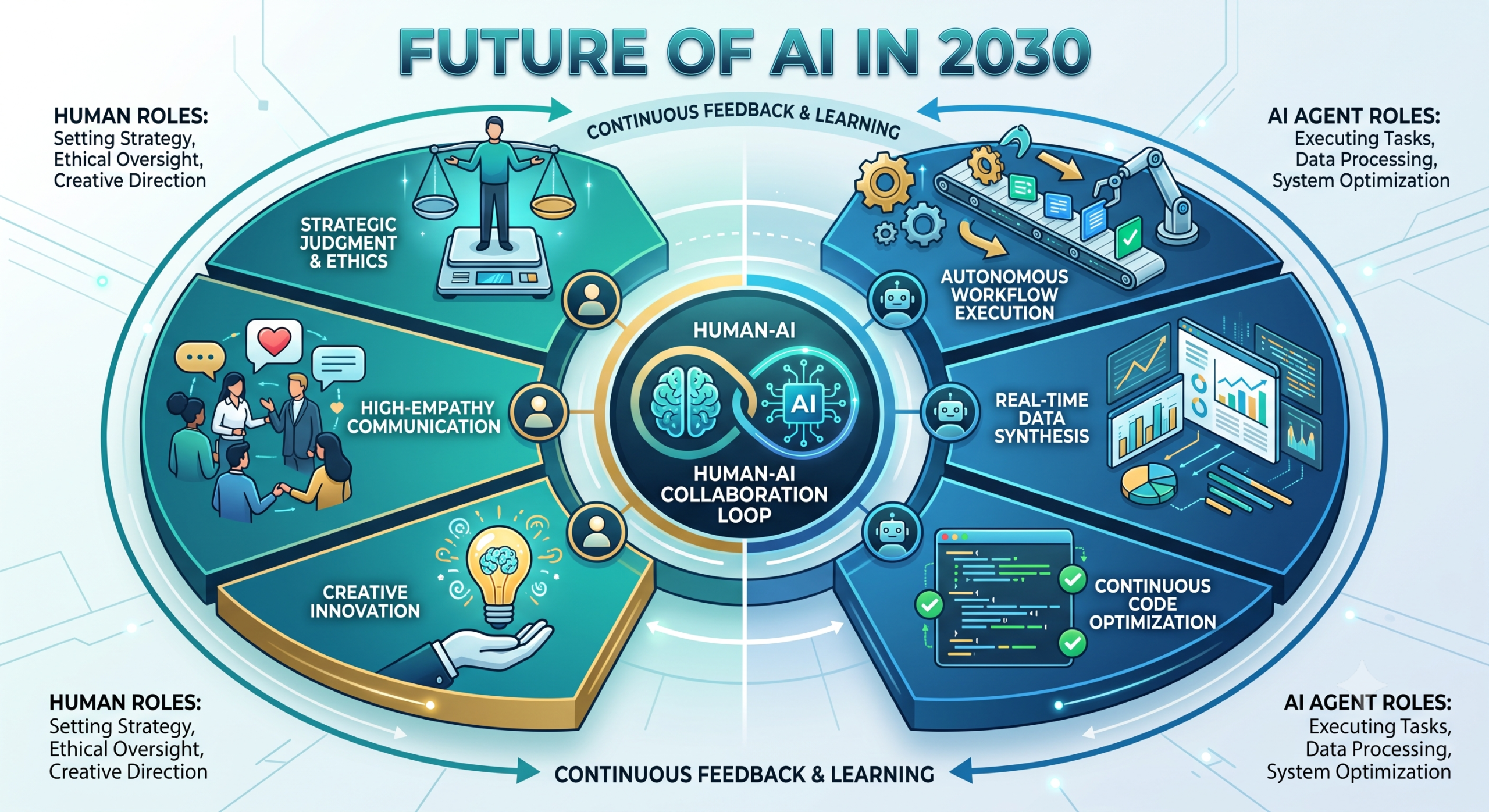
Future of AI in 2030 will change the world: adding $15.7T via digital twin healthcare, smart finance, and automated workforces.
Introduction
Imagine waking up and experiencing the future of AI in 2030. Your morning routine is smooth: you no longer juggle disconnected smartphone apps because a cohesive ecosystem of smart digital entities handles your day. An AI assistant has already checked your morning calendar. It cross-referenced your health metrics using a wearable sensor. It even adjusted your commute to bypass a sudden traffic jam.
This is not science fiction. It is the reality we are accelerating toward. The future of AI in 2030 represents a massive structural shift. We are moving from passive tools that need prompts to autonomous systems. These systems execute complex, multi-step logic with minimal human oversight. Over the next few years, how artificial intelligence will transform the world will become obvious. It will rewire our global economy, healthcare systems, and everyday work frameworks.
The Macroeconomic Picture: The 2030 AI Economic Reality
The financial trajectory of this technological shift is unprecedented. According to global research from PwC, artificial intelligence is projected to contribute up to a staggering $15.7 trillion to the global economy by 2030. Rather than simply driving corporate cost-cutting, this massive influx of capital will stem from hyper-customized product offerings, massive labor productivity gains, and entirely new business paradigms.
Furthermore, Gartner predicts that by 2030, performing inference on a large language model (LLM) with 1 trillion parameters will cost generative AI providers over 90% less than it did in 2025. This 100-fold increase in cost-efficiency means that computing power will become democratized, making hyper-intelligent systems affordable for small businesses and enterprise giants alike.
1. The Autonomous Enterprise: Shift to Agentic Workforces
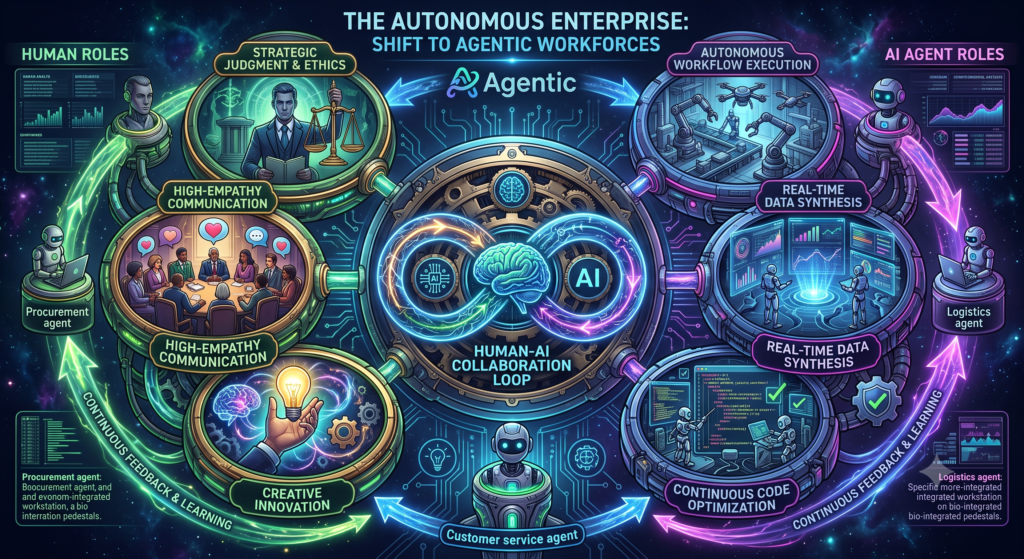
By 2030, standard conversational chatbots will be a relic of the past. The corporate world will transition completely to Agentic AI—autonomous software systems capable of planning, executing, and optimizing complex business workflows independently.
From Task Completion to Decision-Making
- The 25% Autonomous IT Floor: A prominent Gartner survey conducted among CIOs highlights that by 2030, approximately 25% of all information technology work will be handled by autonomous. AI systems completely unassisted by humans.
- Real-Time Strategic Finance: In corporate finance, agentic workflows will make at least 15% of daily decisions autonomously. Traditional monthly or quarterly financial closes will be replaced by continuous, real-time auditing and algorithmic forecasting.
- Touchless Supply Chains: Over 70% of large-scale organizations will adopt touchless forecasting systems. By replacing legacy statistical tools with deep reinforcement learning, supply chains will dynamically adapt to global shipping anomalies, weather events, and geopolitical developments without requiring human intervention.
2. Next-Gen Medicine: Hyper-Personalized and Predictive Healthcare
If there is one sector where the future of AI in 2030 will deliver its most human-centric impact, it is medicine. The current paradigm of reactive healthcare—treating patients after symptoms emerge—will give way to ultra-precise, preventative care.
2.1 The Dawn of Digital Twins
By 2030, medical providers will routinely deploy advanced virtual biological models, known as medical Digital Twins.
                                    [Patient Genomic Sequencing + Real-Time Biomarker Tracking]
                                                                                     │
                                                                                    ▼
                                                      ┌──────────────────────┐
                                                      │                Medical Digital Twin         │
                                                      └──────────────────────┘
                                                                                   │
                                       ┌────────────────┴────────────────┐
                                       ▼                                                                                     ▼
                        [Simulate Drug Efficacy]                              [Predict Organ Stress Years Before Onset]
These digital duplicates will allow oncologists to test thousands of simulated chemotherapy variations on a patient’s exact genetic profile in a virtual sandbox before administering a single physical dose, eliminating devastating trial-and-error periods.
Generative Molecular Design
Traditional pharmaceutical drug discovery takes an average of 10 to 12 years and costs billions. By 2030, generative chemistry platforms will construct entirely new, stable, and highly targeted small molecules from scratch in days. Deep learning models will predict exactly how these synthetic proteins bind to human receptors, slashing early-stage drug development timelines by over 80%.
3. The Structural Evolution of the Global Labor Market
A common point of anxiety regarding how artificial intelligence will transform the world centers on job displacement. However, the data points to a massive workforce transformation rather than a net-negative job elimination event.
The Two-Track Labor Market
Economic data published in the PwC AI Jobs Barometer reveals a fascinating trend: jobs highly exposed to artificial intelligence are demonstrating. as you know 40% higher productivity growth and are expanding headcounts faster than non-exposed roles. AI is currently creating a two-track labor market split into two distinct paths:
- Professionalized Roles: Positions where human expertise is augmented and amplified by AI. These roles are experiencing double the growth rate of traditional positions and a 42% faster wage growth.
- Democratized Roles: Tasks that used to require niche training but can now be performed easily by non-experts using natural language interfaces.
The Compression of the Career Ladder
AI agents will effortlessly handle routine info retrieval and data synthesis. They will also manage junior-level code generation.
Because of this, entry-level corporate roles will undergo a massive evolution. Junior employees in 2030 must possess traditionally “senior” strategic skills much earlier in their careers. They will need strong systems thinking, sharp risk judgment, and cross-functional management. Instead of doing the heavy lifting, they will orchestrate squads of digital agents.
4. Decoupling the Hype: The Sovereign and Ethical Infrastructure
To accurately comprehend the future of AI in 2030, we must address the structural guardrails that will emerge to protect global data privacy and regional security.
4.1 The Rise of Sovereign AI
The early era of AI relied heavily on centralized, monolithic cloud infrastructure dominated by a handful of tech conglomerates. By 2030, we will see the full realization of Sovereign AI clusters. Nations will demand that AI models be trained on local cultural data, compliant with native privacy frameworks, and hosted entirely on domestic, specialized semiconductor infrastructure.
4.2 Advanced On-Device Compute
Rather than constantly pinging centralized servers for every single cognitive request, the physical devices of 2030—ranging from smartphones to autonomous electric vehicles—will run highly optimized, domain-specific small language models locally on advanced neuromorphic processing chips. This will guarantee absolute user privacy, zero latency, and functional operational capability even when completely disconnected from the internet.
Conclusion:
Preparing for the 2030 Paradigm Shift
The conversation around the future of AI in 2030 must move past superficial questions about whether algorithms will replace human workers. As we look toward the end of the decade, it is clear that how artificial intelligence will transform the world is through a symbiotic framework: AI will handle the high-frequency execution of complex data workflows, liberating human minds to focus entirely on strategy, creativity, empathy, and ethical governance.
To remain competitive in this fast-approaching landscape, organizations and professionals cannot afford to take a passive approach. You must actively integrate agentic automation into your current operations, re-skill your teams for decision-oversight competencies, and build an agile technological foundation that can safely ride this exponential wave.
How is your organization adapting its strategy to meet the upcoming 2030 AI reality? Contact our digital transformation strategy team today to design an optimized roadmap that positions your enterprise at the forefront of the autonomous era.
Related Authority Resources (External Links)
- PwC Global Economy Impact Study: Learn more about the projected macroeconomic impacts and data points at pwc.com/gx/en/issues/analytics/assets/pwc-ai-analysis-size-of-the-prize-report.pdf
- Gartner IT Infrastructure Forecasts: Review full research data on computing costs and agentic infrastructure projections at gartner.com/en/newsroom/press-releases