
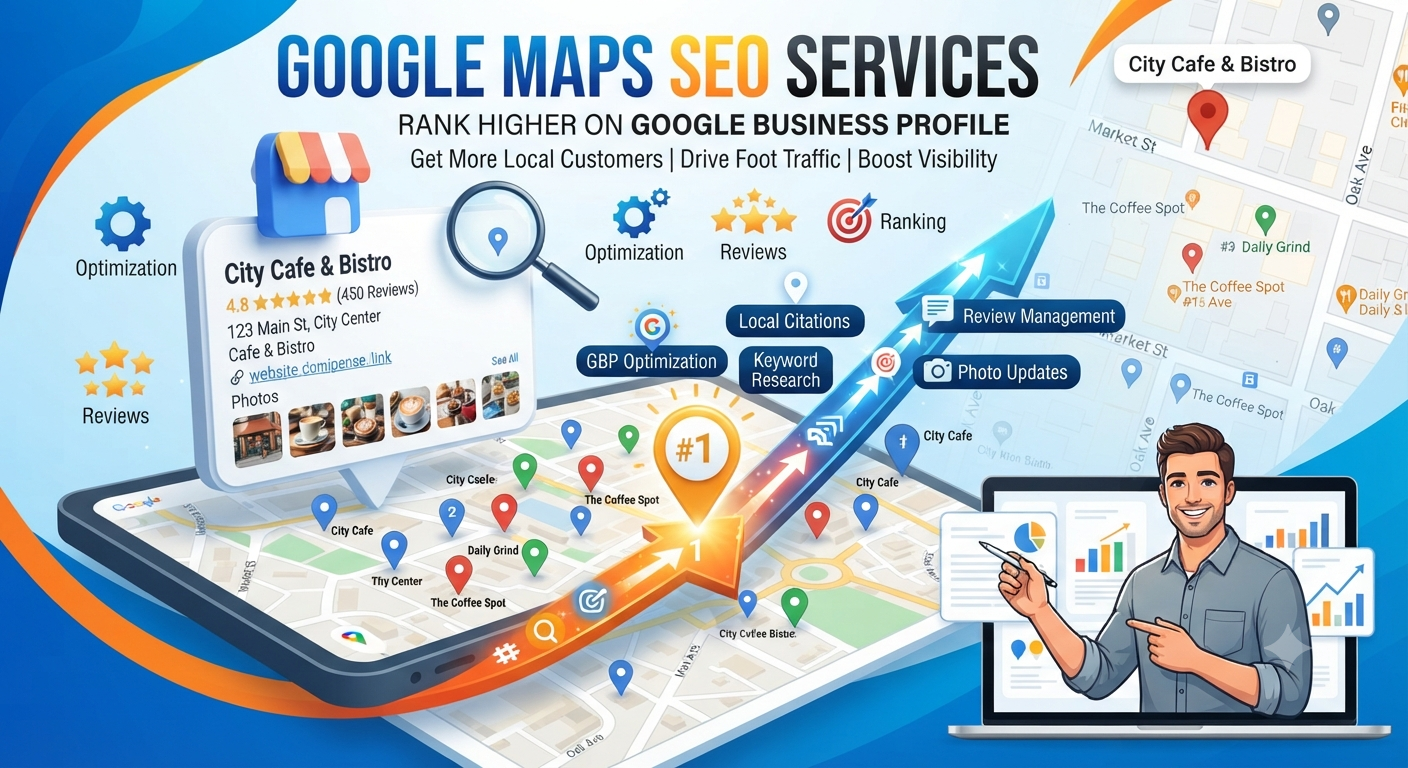
I got a call last month from a guy who owns three HVAC shops in Ohio. He’d paid an agency $4,000 for Google Maps SEO services, hoping to boost his ranking. Six weeks in — nothing. Not one spot moved. I pulled up his profile and saw why. Category still set to “Contractor,” not “HVAC Contractor.” Four reviews, all from 2022, gathering dust. That’s this industry in a nutshell. Everyone’s selling the sizzle. Nobody’s checking the stove.
Only 35% of small businesses have even claimed their Google Business Profile. Two-thirds haven’t taken step one — yet they’ll swear local SEO doesn’t work. It works. Most people just aren’t doing it.
Why Google Maps SEO Services Matter More Than Ever
The Local Pack — those three map results with pins that show up above organic listings — appears in roughly 93% of local searches now. Not most. Almost all of them.
And people click it. 42% of local searchers click a map pack result before they scroll anywhere else. That’s a huge chunk of intent-driven traffic sitting right there, three slots wide, and most businesses are fighting over it with a half-finished profile and a stock photo of their storefront from Street View.
I’ve noticed something else in the data that a lot of “experts” gloss over: complete profiles get roughly 7x more clicks than incomplete ones. Not double. Not 20% more. Seven times. That’s not a rounding error — that’s the difference between a business that gets found and one that doesn’t exist to Google at all.
What “Google Maps SEO Services” Actually Involves
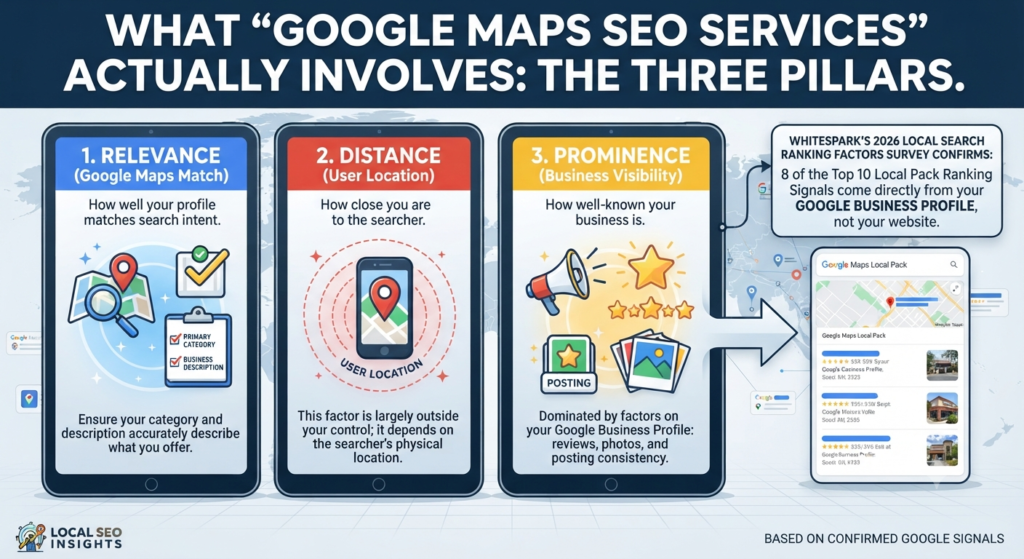
Here’s where I’ll be blunt, because a lot of agencies dress this up as more complicated than it is. Genuine Google maps SEO services come down to three pillars Google itself has confirmed for years: relevance, distance, and prominence .You can’t do much about distance — that’s the searcher’s location, full stop. But relevance and prominence? That’s the whole ballgame, and it’s mostly controllable. According to Whitespark’s 2026 Local Search Ranking Factors survey — which polls around 47 working local SEO experts, not armchair theorists — eight of the top ten ranking signals for the map pack come directly from your Google Business Profile. Not your website. Not your backlinks. Your profile
That means the primary category you select, the completeness of your business description, your review velocity, your photos, your posting cadence — these carry more weight than almost anything happening off-platform.
A few things I’d tell any business owner before they hire someone:
- Posting weekly on your GBP correlates with meaningfully better visibility than posting sporadically or not at all..
- Your primary category is the single most controllable ranking factor. Get it wrong, and you’re invisible for searches you should be winning.
- Reviews aren’t just a trust signal for humans anymore — they’re a ranking input, and quality is starting to matter more than raw count.
A Real Example (Because Vague Case Studies Annoy Me)
I mentioned the Ohio HVAC company earlier. Once we fixed the category, added service-area pages tied to actual neighborhoods instead of generic “HVAC repair near me” fluff, and got the owner texting happy customers a review link right after the job — not weeks later — his call volume from GBP actions rose noticeably within about ten weeks. That’s roughly in line with what the broader data shows: GBP-driven actions (calls, direction requests, website clicks) grew 41% year-over-year industry-wide between 2025 and 2026.
Compare that to a dentist’s office I audited in early 2026 that had 340 reviews — an enormous number — but hadn’t responded to a single one since 2023. Their competitor down the street had 90 reviews and answered every one within 48 hours. The competitor outranked them in the pack. Quantity used to be king. It isn’t anymore, or at least not alone.
My Contrarian Take on Google Maps SEO Services
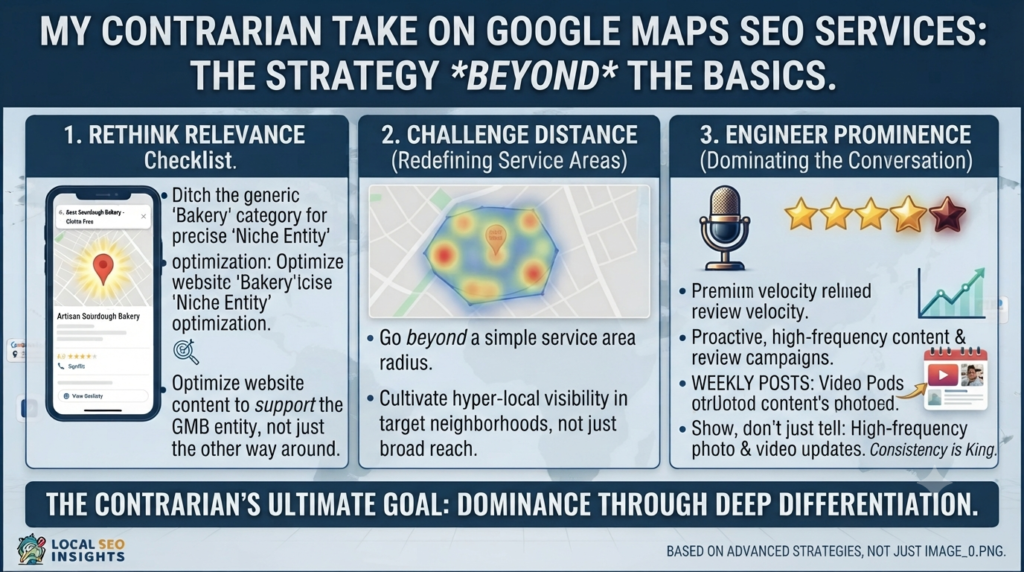
Most of the industry is currently obsessed with “AI visibility” — getting your business named by ChatGPT or Gemini instead of just Google Maps. And look, it’s real; AI recommendation visibility is reportedly around 30 times harder to achieve than ranking in traditional local search, and less than half of businesses leading in Google’s local results even show up in AI recommendations at all.
Not everyone in the industry agrees with me on that ordering, to be fair. Some argue the AI shift is happening so fast that businesses ignoring it now will be structurally behind by 2027. Maybe. I just haven’t seen the traffic numbers back that urgency up yet.
DIY vs. Automated Tools vs. Hybrid Approach
| DIY (Owner-Managed) | Automated/AI-Only Tools | Hybrid (Agency + Owner) | |
|---|---|---|---|
| Time cost | High — owner does everything | Low — mostly hands-off | Moderate — shared responsibilities |
| Category & profile accuracy | Often incomplete or wrong category | Good at flagging errors, weak at strategy | Strong — expert-set, owner-verified |
| Review response quality | Inconsistent, reactive | Generic, templated replies | Personalized, timely |
| Local content (service pages) | Rarely built | Not addressed | Built and localized |
| Cost (monthly) | $0 (opportunity cost) | $50–$200 | $500–$2,500+ |
| Best fit | Solo operators, tight budgets | Businesses wanting basic hygiene only | Multi-location or competitive markets |
I’ll say this simply: automated tools are not bad they are just not complete. They are good at finding inconsistencies in business names, addresses and phone numbers and at pointing out missing information. However they struggle with writing review responses that sound natural or with understanding why a competitor is ahead for example because they created a page, for emergency water heater replacement services, which you did not do.
Where This Is Headed
Impressions on Google Business Profiles actually fell over 50% year-over-year recently — largely because AI Overviews are intercepting a chunk of browsing-stage searches before they ever reach the map pack. But here’s the part that should calm nervous business owners down: actual customer actions, the calls and direction requests that pay the bills, barely moved. High-intent searchers are still clicking through. The casual browsers are the ones getting absorbed by AI summaries.
So no, the map pack isn’t dying. It’s getting more competitive among a shrinking pool of businesses that actually bother to optimize it properly.
nternal Linking Ideas (for your own site)
- “How to Write a Google Business Profile Description That Converts”
- “Local SEO Checklist for Multi-Location Businesses”
- “Review Response Templates That Don’t Sound Robotic”
External Sources Worth Reading
- BrightLocal’s Local Search Ranking Factors survey
- Google’s own guidance on local ranking factors
- Whitespark’s ranking factors research
FAQs
A: Traditional SEO focuses on ranking your website globally or nationally. Google Maps SEO (Local SEO) is specifically designed to get your business into the “Local Pack”—the top three map results that appear when users search for services in their immediate area.
A: Both are important, but Google now prioritizes “quality” and “recency.” A steady stream of detailed, recent reviews signals to Google that your business is active and trustworthy.
A: Definitely not. Google’s AI is highly effective at detecting fake activity. Relying on fake reviews carries a high risk of your business profile being suspended or banned.
Conclusion
Google Maps SEO isn’t about secret tricks; it’s about consistency. Most competitors fail because they neglect the basics—a complete Google Business Profile, accurate categorization, and genuine customer engagement. By focusing on these core signals rather than chasing vanity metrics, you can outperform most local businesses. Clean up your profile today, and you’ll see the impact in your calls and direction requests within weeks.