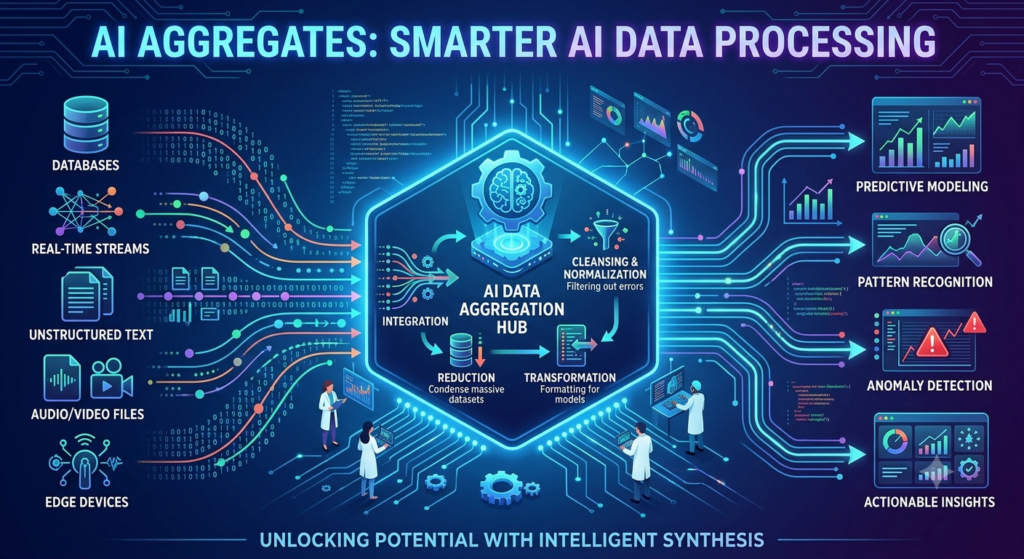

Introduction
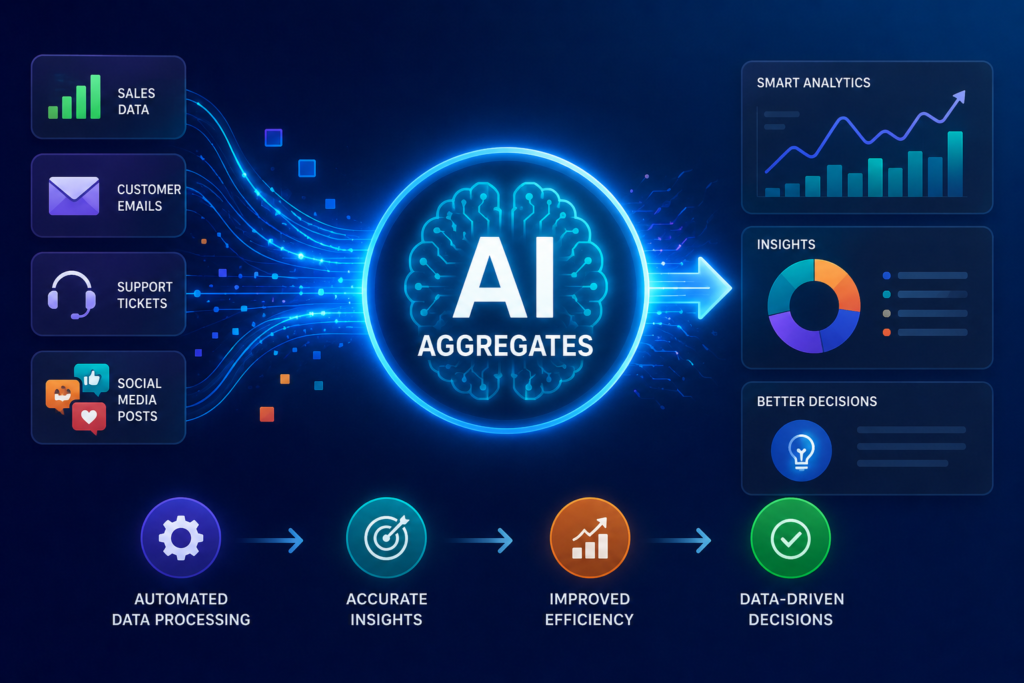
Every business today has a lot of data. They get sales numbers, customer emails, support tickets and social media posts. It all adds up fast. For a time companies used simple data tools to manage it all. They would add up totals find averages and build reports. This worked when data was numbers in rows and columns. It does not work anymore. AI aggregates are changing this.
Understanding AI Aggregates and Data Processing
They help organizations make sense of their data quickly. This shift is changing how companies think about information. AI aggregates are making data processing easier for everyone.
Making Better Decisions with AI Aggregates
Companies use these tools to unlock data processing. This helps them make decisions. AI aggregates help businesses understand their data better.
The Future of Growth: Next-Gen AI Data Collection
The use of AI aggregates is growing fast. More companies use them to process data. This is changing the way businesses work. They are becoming more efficient every day.
So what are Artificial Intelligence Aggregates?
Think about the traditional way of putting together data, like adding up monthly sales or finding the average number of website visits. While it is useful, it does not tell us much. For example, it tells us what happened, but it does not tell us why it happened. Furthermore, it also does not help us figure out what is going to happen next.
In contrast, Artificial Intelligence Aggregates do more than the traditional way. They use machine learning and language processing to make sense of the data. Therefore, they can look at emails, phone calls, and videos to find patterns quickly. In short, the old way just counts things, whereas AI Aggregates really understand what the data means.
In short, the old way of aggregating data just counts things, whereas Artificial Intelligence Aggregates really understand what the data means.
How Far We’ve Come
It helps to see things side by side. Old-style data collection mainly dealt with data like spreadsheets, databases and CSV files. It used batch processing so you’d wait for a scheduled job to do its thing overnight or once a week. The rules were. Hard to change.
AI-powered data collection changes everything. It handles data, somewhat neat data and totally messy data like text, pictures and audio. Processing happens away so you get insights as things happen, not days later. These systems learn and adjust as things change so they give you something useful than a report, on what already happened. They tell you what happened, why it happened and what might happen next.
That’s the deal. Businesses aren’t just looking back anymore. They’re making decisions based on whats coming. A delivery company for example doesn’t just want to know that deliveries were late month. It wants a system that warns it in the moment that a storm and a staff shortage are going to cause delays Tuesday. Early enough to do something about it.
Why This Actually Matters
There are a few reasons why companies are trying to use this technology. They are not doing it just to follow the trend.
This technology can handle data. 80 Percent of the data that companies have is unstructured. This includes emails, PDFs, chat logs and recorded calls. Old tools could not handle this type of data because they were not able to process it. Artificial Intelligence can read thousands of customer reviews understand how people feel about a product and find complaints. It can do all of this in a few seconds, not weeks.
This technology can clean up data automatically. People who work with data know that it is often a mess. There are duplicates, typos, missing information and formatting issues. Cleaning up this data used to take a lot of time. In fact it used to take time than actually analyzing the data. Artificial Intelligence can now handle this work. It can remove duplicates fix formatting issues and even predict information. This means that teams can focus on analyzing the data of just cleaning it up.
Data Summarization
This technology can summarize data of just showing numbers. Nobody wants to look at a spreadsheet with thousands of rows of numbers. They want to know what the numbers mean. Artificial Intelligence can create summaries that explain the story, behind the numbers. This makes it easy for people to understand the data even if they are not experts. A marketing manager should be able to understand why customers are leaving without needing to be a statistics expert.
This technology can handle amounts of data without any problems. The amount of data that companies have is always growing. Artificial Intelligence models are designed to grow with this data. Companies can handle amounts of data without having to rebuild their entire system every few years. In the past companies had to hire people and buy more equipment to handle the data. Now they just need to use computing power, which is easier to do. Artificial Intelligence is making it possible for companies to work with amounts of data in a more efficient way.
Where This Shows Up in Life
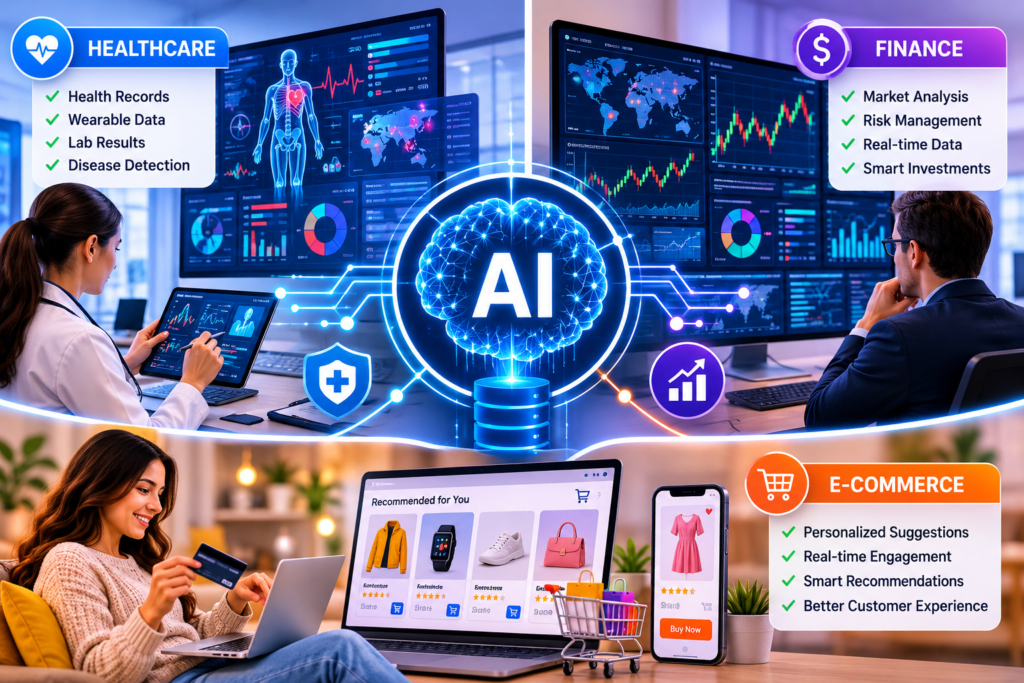
This is not just something we talk about. It is actually changing whole industries right now.
In healthcare Artificial Intelligence aggregates are putting together information from health records data from wearable devices and lab results for a lot of patients. This helps doctors and researchers find out about disease outbreaks early and make treatment plans that’re better for each patient. For example a hospital network might see that a lot of people are having the symptoms in several clinics a few days before it is officially reported. This gives the people in charge of public health a big head start.
AI Aggregates in Finance and E-commerce
In finance companies that invest money give Artificial Intelligence systems a lot of information all the time like news from around the world stock market data and what people’re saying on social media. The Artificial Intelligence aggregates all of this information to figure out what might happen in the market. Even makes trades automatically faster than any human can. The teams that look at risk also use these systems to keep track of how money they might lose across thousands of investments in real time instead of waiting until the end of the day.
AI in E-commerce
In e-commerce online stores combine what people have looked at before what they have bought and even the weather where they live to suggest products that seem personalized. And they do it while the person is still shopping.
If it suddenly gets cold in one area the store might start suggesting jackets and heaters within minutes without anyone having to change anything.
AI Aggregates in Manufacturing
Artificial Intelligence is also being used in manufacturing, where it aggregates data from sensors on the factory floor to predict when equipment might break down so it can be fixed before it stops working.
Smart Data Aggregation in Customer Support
It is used in customer support, where it aggregates data from customer tickets to find out about problems with products before they become issues.. It is used in media, where it aggregates data, about what people are watching across different platforms to decide what kind of content to make almost as it is happening.
What to Watch Out For
None of the Data Aggregation comes free of challenges. It is worth being honest about the Data Aggregation challenges.
First of all, data quality still matters enormously.” The Data Aggregation can clean up a lot of mess. If the underlying data is fundamentally flawed or biased the Data Aggregation will simply amplify those flaws faster than a human ever could.
Remember that the idea that garbage in garbage out still applies is very true for the Data Aggregation.“It just happens at a larger scale now.”
Moving on, privacy and compliance can not be an afterthought for the Data Aggregation. When you are pulling together health records, financial data or personal browsing habits for the Data Aggregation you are also taking on responsibility for how that data is stored.
Crucially, regulations like GDPR and HIPAA do not disappear just because the Data Aggregation is smarter. If anything the stakes go up for the Data Aggregation.
Another major risk is over-reliance on the Data Aggregation. It is tempting to treat the Data Aggregation insights as the truth especially when they arrive instantly and sound confident.
As a matter of fact, the Data Aggregation systems can misread context especially with sarcasm, cultural nuance or genuinely novel situations they have not seen before for the Data Aggregation. Smart organizations treat the Data Aggregation as an assistant, not a replacement for human judgment.
Finally, integration of the Data Aggregation takes effort. Plugging a Data Aggregation system into decades- legacy infrastructure is not always as easy as vendors make it sound. Companies still need to invest time in getting their data pipelines, APIs and internal processes ready to take advantage of what the Data Aggregation systems can do.
Where This Is Headed
The direction of travel is pretty clear. As models get better at handling multiple data types at once — text, image, audio, and video together rather than separately — AI aggregates will get even better at building a single, coherent picture out of genuinely messy, real-world information. Expect these systems to get faster, cheaper to run, and more accessible to smaller organizations that couldn’t previously afford this kind of sophistication.
There’s also a growing push toward aggregation systems that don’t just report insights but recommend or even take actions directly, closing the loop between “here’s what’s happening” and “here’s what we did about it.” That shift — from insight to action — is where a lot of the next wave of value is likely to come from.
The Real Takeaway
Here’s the thing about data: it’s completely worthless if you can’t turn it into a decision. Piling up numbers doesn’t help anyone. What helps is understanding what those numbers are telling you and acting on it quickly.
That’s the shift AI aggregates represent. Moving from simple data collection to genuinely intelligent aggregation lets businesses break down the data silos that have quietly held them back for years, cut down processing time from days to seconds, and make sharper decisions with a level of confidence that just wasn’t possible before. Companies that make this shift early aren’t just keeping up with the competition — they’re setting themselves up to actually see around corners their rivals can’t. And in a business landscape where speed and insight decide who wins, that’s not a small advantage. It might be the whole game opportunities before others do. They’ll make decisions with a level of confidence that wasn’t possible before. As data grows in volume and complexity the gap between businesses that use AI aggregates and those that don’t will grow.
The message is simple: the future of data processing isn’t about collecting information. It’s, about understanding it. AI aggregates deliver that. They help businesses understand their data better and make decisions.
Conclusion
At the end of the day, data by itself is just noise. It’s the ability to turn that noise into a clear signal — quickly, accurately, and at scale — that separates companies that thrive from companies that fall behind. AI aggregates make that possible in a way traditional methods simply can’t match. They don’t just tally up numbers; they read between the lines, connect scattered pieces of information, and hand decision-makers something they can actually act on.
The organizations that adopt this shift early won’t just save time or cut costs, though they’ll certainly do both. They’ll build a genuine edge — spotting risks before they escalate, catching opportunities before competitors even notice them, and making calls with a level of confidence that used to be impossible. As data keeps growing in volume and complexity, the gap between businesses that embrace AI aggregation and those that stick with outdated methods will only widen.
The message is simple: the future of data processing isn’t about collecting more information. It’s about understanding it better. And that’s exactly what AI aggregates deliver.