
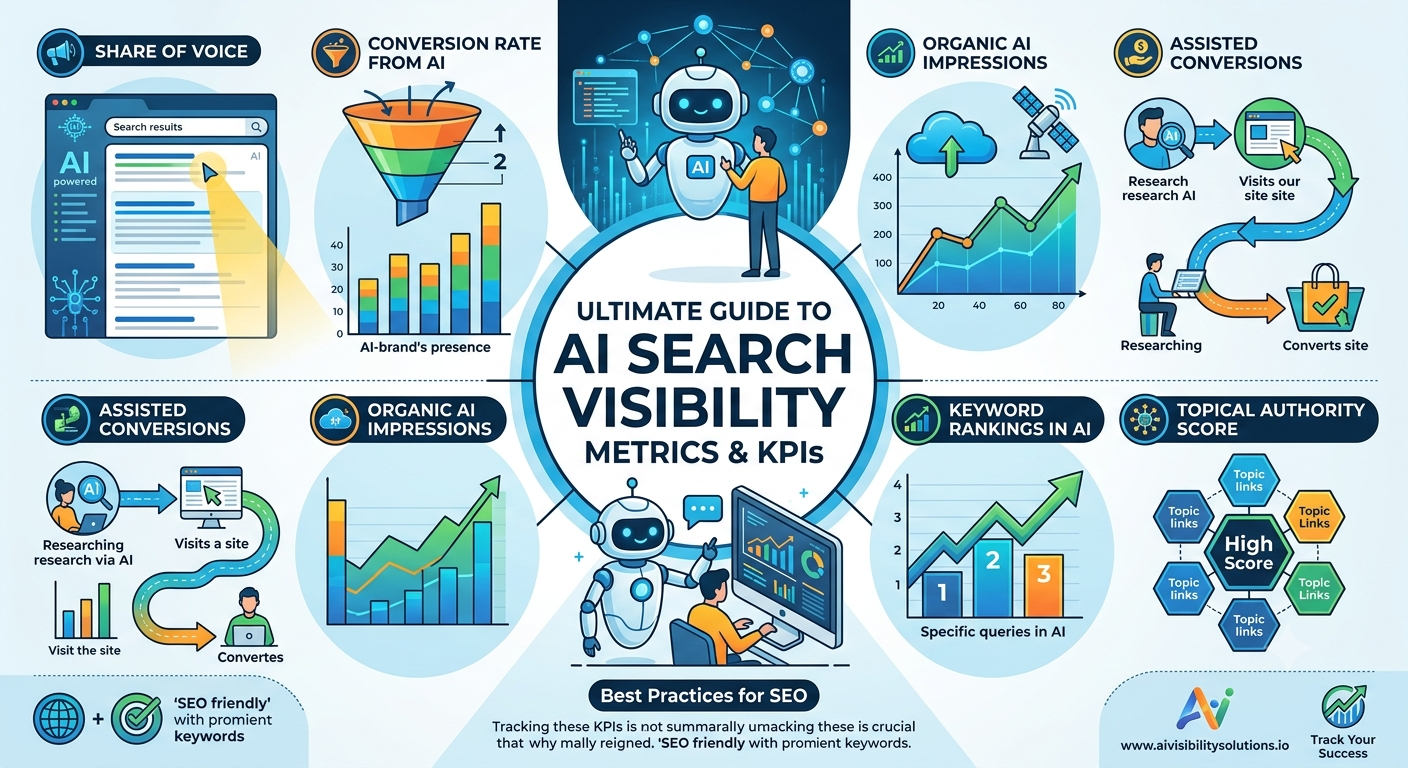
Learn the AI search visibility metrics KPIs that actually matter in 2026 citation rate, share of voice, sentiment, and more.
Introduction
your brand just got recommended by ChatGPT to a qualified buyer. It showed up in a Google AI Overview. Perplexity cited your blog post as a source. And your analytics dashboard? It shows nothing. Zero clicks, zero sessions, zero credit. This is the blind spot swallowing modern marketing teams. Traditional SEO metrics were built for a world of blue links and clicks. But AI search now answers questions directly, inside the chat window, without ever sending a visitor to your site. If you’re still reporting on organic traffic alone, you’re measuring a shrinking slice of your real visibility.
key AI Search Visibility Metrics kpIs
Search behavior has fundamentally shifted. Instead of scanning ten blue links, users now get a synthesized answer from ChatGPT, Gemini, Google AI Mode, or Perplexity and often stop there. This creates a measurement gap that AI search visibility metrics KPIs are specifically designed to close. They answer questions traditional analytics simply cannot:
- Does your brand appear when AI tools answer category-level questions?
- How is your brand described when it does appear?
- Are you winning or losing share of voice against competitors inside AI answers?
- Is that invisible exposure actually influencing pipeline and revenue?
The Problem With Relying on SEO
Rankings, impressions, and click-through rate all assume one thing: a user clicks. AI-generated answers break that assumption.
Why Clicks and Rankings Fall Short
Rankings don’t translate directly
Why Volatility Makes This Even Harder Zero-click answers are now common. When an AI summary fully satisfies a query, users have no reason to click through, even if your brand was featured prominently. AI search visibility metrics KPIs also need to account for the fact that AI answers aren’t static. Research from AirOps on AI Search metrics found that only around 30% of brands remain visible from one AI-generated answer to the next, and that number drops to roughly 20% across five consecutive runs of the same prompt. In other words, a single check tells you almost nothing you need repeated sampling and trend lines, not one-off snapshots.
AI Search Visibility Metrics in 2026
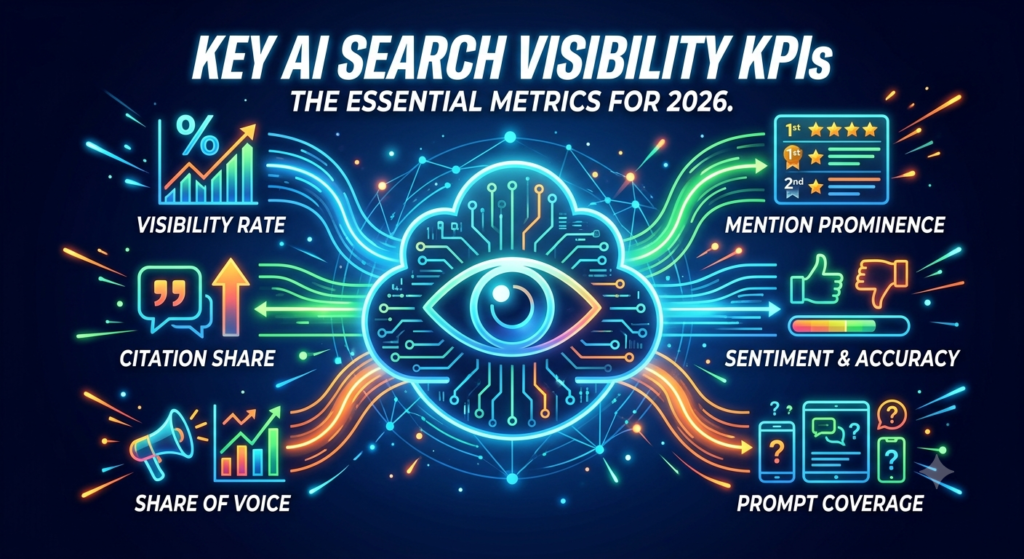
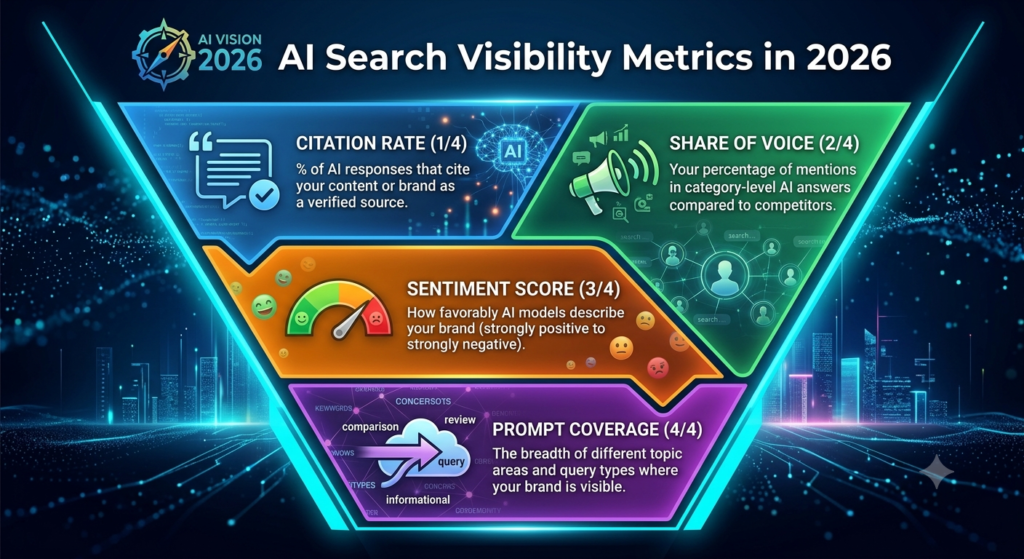
Below are the foundational AI search visibility metrics KPIs that should sit at the center of any modern measurement dashboard.
1. AI search Visibility Rate
This is your baseline metric. It measures the percentage of relevant prompts where your brand appears at all.Formula: Mode. A brand appearing in 30% of tracked queries has a working baseline if that number drops to 15%, something changed in how the model retrieves or trusts your content.
2. Citation Share
Citation share is arguably the single most important of all AI search visibility metrics KPIs, because it tells you not just whether you’re mentioned, but whether your content is being relied on as a source. Formula: (Your brand’s citations ÷ Total category citations) × 100.
3. Share of Voice (SOV)
Borrowed from traditional marketing, AI share of voice compares how often your brand appears in AI answers relative to named competitors within the same query set. Example: If ten AI responses about your product category mention.
4. Brand Mention Prominence (Rank/Position)
AI answers don’t have fixed rankings, but position still matters. Being mentioned first in a response carries more weight than being listed third or buried in a footnote citation. Track your average position across repeated prompt runs to see whether you’re leading the answer or trailing behind it.
5. Sentiment and Accuracy Score
- Sentiment score typically ranges from strongly negative to strongly positive, tracking how favorably AI models describe your brand.
- Accuracy checks whether the AI is describing your product, pricing, or positioning correctly misrepresentation can quietly damage conversions even when visibility looks strong.
6. Prompt Coverage
This measures the breadth of topics and query types where your brand shows up not just branded searches, but comparison queries, “best of” lists, and problem-solution prompts across the buyer journey.
AI Search Visibility Metrics Dashboard
- Define a fixed prompt set. Build 30–50 category-relevant prompts split by intent (branded, comparison, problem-solution) and keep the set stable across reporting periods changing prompts mid-cycle will fake “growth” that isn’t real.
- Sample repeatedly, not once. Given how volatile AI answers are, run your prompt set multiple times per week and report a rolling average with a confidence range (for example, “Citation Share: 24% ± 3%”).
- Separate AI metrics from traditional SEO metrics. Don’t let AI Overview impressions blend into your regular organic traffic reports track them as their own category.
- Report outcome language, not jargon. Instead of telling stakeholders “we appear in 42% of tracked prompts,” say “AI tools now recommend us in nearly half of category comparison questions.
A Quick Real-World Example
One widely cited case in the AI visibility space involved a fintech brand auditing its AI presence and discovering that language models were repeatedly pulling negative sentiment from a low-quality review site one where a large share of the negative reviews traced back to single-review accounts unrelated to genuine customers. Fixing that one source materially improved how AI models described the brand within weeks. That’s the kind of actionable insight raw traffic
Common Mistakes
- Treating a single scan as truth. One prompt run is a snapshot, not a trend.
- Ignoring platform differences. ChatGPT, Perplexity, and Google AI Overviews cite and structure sources differently — normalize your data before comparing them.
- Dropping traffic metrics entirely. Traffic still signals real intent from users who click through; it should sit alongside AI metrics, not replace them.
- Expanding the prompt set mid-quarter. This inflates “mentions” without reflecting real improvement.
- Skipping sentiment. A brand can be highly visible and still be losing the conversation if AI tools describe it unfavorably.
Final Thought;.
Ready to get a handle on your brand’s AI visibility?
Start by auditing how your brand currently appears across ChatGPT, Gemini, and Perplexity for your top ten category queries then use the KPIs above to turn that audit into an ongoing dashboard your whole team can rally around.