
Introduction
When an artificial intelligence system performs as intended but answers the wrong challenge, it highlights the need for business context refinement. Without this alignment, even the most advanced AI solutions fail to deliver real organizational value.
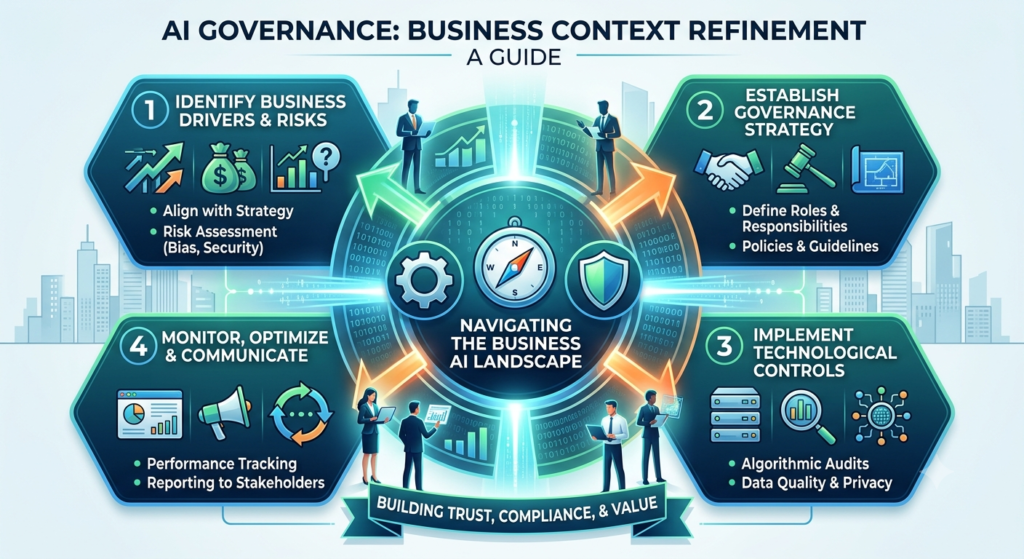
AI Governance Business Context Refinement is the central issue of contemporary artificial intelligence governance. Many companies are rushing to implement AI technologies to handle challenges such as customer service, marketing, fraud, recruitment, analysis, and content generation. However, just doing something fast doesn’t mean you’re creating value. In fact, without business context, a sophisticated artificial intelligence technology may generate results that are unethical, inaccurate, dangerous, or financially damaging.AI Governance Business Context Refinement is a technique that links AI decision-making with the actual goals of the business organization, interests of stakeholders, duties and liabilities, and risks. Through the refinement, businesses go beyond abstract phrases like “we are going to implement AI in order to increase efficiency.” Rather, they clarify what efficiency is, who will be affected by it, what data is suitable, what results are acceptable, and how humans should interfere.
It is important because AI technologies are not used in isolation. Recommendation system impacts customer purchases. Recruitment models affect the availability of employment. Generative AI assistant reveals company secrets when employees use it improperly. OECD mentions that trustworthiness of AI depends on many factors such as fairness, privacy, transparency, robustness, and accountability at each stage of AI life cycle.But there’s no need for responsible AI to hinder innovation. With effective business context refinement from the start, companies will be able to choose the right projects, prevent unnecessary failure, and increase the trust of their employees, customers, and regulators.This guide explains what business context refinement is, why it should be a part of AI governance, how to develop a governance process, and how to implement responsible AI into your business practice.
Why AI Governance Business Context Refinement Matters
AI governance is often misunderstood as a legal checklist or an IT-only responsibility. In reality, it is a business discipline. It determines how an organization chooses, develops, deploys, monitors, and retires AI systems.Business context refinement makes governance practical. It asks simple but essential questions: What business decision is AI supporting? Who benefits? Who could be harmed? What is the cost of being wrong? What does success look like six months after launch?
For example, imagine a retailer using AI to predict which customers should receive discount offers. Initially, the goal may simply be to “increase sales.” However, a refined goal is much more useful…”: “Increase repeat purchases among opted-in customers without using sensitive personal data, while ensuring discount allocation does not systematically exclude certain customer groups.”That version gives the data team, marketing team, and compliance team something concrete to work with. It also supports AI accountability, because each team knows its role.The National Institute of Standards and Technology describes its AI Risk Management Framework as a flexible resource for organizations to manage risks and incorporate trustworthiness into AI design, development, use, and evaluation. Its core functions are Govern, Map, Measure, and Manage.
“Good AI governance begins with a business question, not a technology purchase.”
Actionable tip: Before approving an AI project, require a one-page “context brief” covering the business objective, intended users, affected groups, data sources, risks, owner, and success metrics.
Define the Business Problem for Context Refinement
A better strategy would be to start from a business problem. Is there even a need for AI here? In some cases, it may be solved by a more efficient process re-engineering, learning, or by using a different automation tool.
In order to enhance context definition, note these elements:
Business goal: what effect are we looking for?
Type of decision: is it a recommendation, prediction, generation, or decision by AI?
Level of impact: can the output influence any financial, employment, security, privacy or other issues?
Potential users and affected parties
Limits: what are the things the AI must not do?
The approach mentioned above ensures AI ethics by prompting the team to take into account the potential impact before the deployment. For example, an automated description generator for product descriptions is not as risky as an AI solution ranking candidates for a job.
| AI Use Case | Typical Risk Level | Recommended Governance |
|---|---|---|
| Writing marketing drafts | Low | Brand review and content policy |
| Customer support chatbot | Medium | Escalation process and privacy controls |
| Loan or hiring recommendations | High | Bias testing, audit trail, human review |
The OECD’s AI Principles emphasize human-centered values, transparency, robustness, and accountability. These principles are useful because they can be translated into business requirements rather than left as abstract ideals.
Actionable tip: Add a “no-AI option” to every project proposal. If a team cannot explain why AI is better than a simpler alternative, pause the project.
Build a Framework for Business Context Refinement
A responsible AI governance framework does not need to begin as a 100-page policy document. It can start with a small, repeatable operating model. The most effective frameworks bring together business, technical, legal, security, privacy, and risk perspectives. This prevents one department from carrying the entire burden.
A practical governance structure may include:
- Executive sponsor: Connects AI initiatives to strategy and budget.
- AI governance lead: Additionally, coordinates standards, reviews, and documentation.
- Business owner: Meanwhile, defines the use case and accepts accountability for outcomes.
- Technical owner: Oversees model development, integration, and monitoring.
- Risk partners: Furthermore, review privacy, security, legal, and ethical concerns.
- Human reviewers: Finally, handle exceptions and high-impact decisions.
This is where AI compliance becomes more manageable. Instead of treating compliance as a late-stage approval, organizations embed it into the AI lifecycle.The NIST AI RMF is voluntary and designed to be adaptable across sectors and organization sizes. That flexibility is valuable for businesses that need a practical starting point rather than a rigid one-size-fits-all template.
Actionable tip: Create three governance lanes: low-risk AI tools can use a lightweight review, medium-risk tools need documented testing, and high-risk systems require formal approval and ongoing monitoring.
Identify Risks, Stakeholders, and Decision Rights
Risk management is not only about preventing a model from producing errors. It also means understanding what happens after an output is used.A model may be statistically accurate and still create business harm. For example, an AI assistant might generate persuasive but incorrect answers. A pricing model may optimize revenue while damaging customer trust. A customer analytics tool may use data in ways people did not expect.
This is why AI risk management should include both technical and business risks:
- Data privacy and confidentiality
- Bias or unfair treatment
- Inaccurate outputs or hallucinations
- Cybersecurity threats
- Intellectual property concerns
- Reputational damage
- Overreliance on automated recommendations
Stakeholder mapping is equally important. Include customers, employees, vendors, regulators, and communities where relevant. Their concerns may reveal risks that technical teams do not immediately see.For high-impact decisions, define decision rights clearly. Who can approve deployment?
Actionable tip: Use a risk register with four columns: risk, likelihood, impact, and mitigation owner. Review it before launch and quarterly after launch.
Create Human Oversight That Actually Works
In order for human oversight to be effective, people should be able to identify the use of AI systems, catch suspicious outputs, make overrides, and raise issues. Crucially, employees must not be penalized for questioning an AI’s recommendation. For instance, if an AI-assisted support agent does not have enough confidence to respond to a billing complaint, the issue should be transferred to a competent human who knows the full history of the conversation. This human review is particularly vital when AI impacts people’s rights, finances, jobs, safety, or access to basic services.
Actionable tip: Identify what situations will require human intervention in advance.
Measure AI Performance Beyond Accuracy
Accuracy is critical but insufficient. A system could be accurate when tested but not when used in reality due to customer behavior shifting, poor data quality, and employees utilizing it in a different way than was intended.
A robust AI governance system keeps track of several metrics:
- Accuracy and error rate
- Fairness among relevant users
- Response time and consistency
- Privacy or security breaches
- Rate of human override
- Complaints by customers
- Value generated for the business
- Model drift
In generative AI, the process of evaluation needs to cover factual accuracy, content safety, prompt injection risk mitigation, and provenance information. The National Institute of Standards and Technology offers Generative AI Profile that helps mitigate potential risks related to generative AI systems.
Actionable tip: Schedule the review process in advance. Low-risk applications might be reviewed every six months, while more significant applications will require monthly reviews.
Turn Context Refinement Into an Ongoing Business Practice
AI governance is not a document stored in a shared folder. Instead, it is a continuous practice that develops along with changes in the model, data, regulatory environment, and business requirements.The best companies embed governance into regular operations. Product teams use context briefs. Procurement teams evaluate AI providers. People get trained. Executives consider AI risks in the same way as they do financial and cybersecurity risks.And that leads to trusted AI since governance comes through in the decision-making process rather than just in the wording of policies.Start with small steps. Pick up a high-impact AI application and use the framework to improve it. And, with time, your company will develop a governance library featuring approved tools, risk templates, test criteria, and best practices.
Actionable tip: Hold a quarterly AI governance review with business leaders, technical owners, and risk teams. Discuss new use cases, incidents, performance trends, and policy updates.
Conclusion
AI can create real business value, but only when organizations understand the context in which it operates. AI Governance Business Context Refinement helps leaders connect innovation with accountability, risk management, and trust.
Here are the key takeaways:
- Start with the business problem, not the AI tool.
- Define stakeholders, risks, and boundaries before deployment.
- Use governance that matches the level of impact.
- Keep humans involved in high-impact or uncertain decisions.
- Monitor AI continuously, not only at launch.
The goal is not to make AI adoption complicated. It is to make it intentional. A well-governed AI system is more likely to earn customer confidence, support employees, and deliver sustainable value.If your organization is planning its next AI project, begin with a simple context brief and ask the questions that matter most: What are we trying to achieve, who could be affected, and how will we know the system is acting responsibly?What AI governance challenge is your business facing right now? Share your thoughts in the comments and start building a more responsible AI future.
FAQs
Q1: What is AI Governance Business Context Refinement?
AI Governance Business Context Refinement is the process of defining the business purpose, stakeholders, risks, boundaries, and success measures of an AI system before and during deployment. It helps make responsible AI practical.
Q2: Why is business context important in AI governance?
Business context ensures AI is connected to a real need. It helps teams avoid unclear goals, inappropriate data use, unmanaged risk, and poor accountability.
Q3: What is responsible AI?
Responsible AI is the design and use of AI in ways that are fair, safe, transparent, accountable, and respectful of privacy and human rights.
Q4: Does every AI tool need the same governance process?
No. Governance should be proportionate to risk. A low-risk writing assistant needs lighter controls than an AI system used for hiring, lending, or healthcare decisions.
Q5: What are the main AI risk management areas?
Key areas include privacy, bias, security, accuracy, explainability, intellectual property, human oversight, and reputational impact.
Q6: How can small businesses start with AI governance?
Small businesses can begin with an AI use-case register, a basic acceptable-use policy, employee training, and a review process for high-risk tools.